

For many B2B buyers, MOQ is one of the first questions when sourcing matcha powder. Whether you run a café, manage a food and beverage brand, distribute ingredients, or plan to launch a private label matcha product, MOQ directly affects your budget, inventory, launch timeline, and pricing strategy.
But matcha MOQ is not always a single fixed number. It can change depending on grade, packaging, certification, customization, production method, and whether you are buying bulk powder or finished private label products.
This guide explains what B2B buyers should know about matcha MOQ before placing an order, so you can plan your sourcing project more clearly and avoid unexpected costs.
What Does MOQ Mean in Bulk Matcha Sourcing?
MOQ means Minimum Order Quantity. It is the smallest quantity a supplier is willing to produce or sell for a specific product, packaging type, or project.
In matcha sourcing, MOQ may apply to several different parts of the order:
- Bulk matcha powder
- Private label packaging
- Printed pouches or tins
- Stick packs or sachets
- Organic-certified matcha
- Custom blends
- Export cartons or special packing formats
This is why one supplier may say “MOQ is 10kg” for bulk powder, while another may say “MOQ is 1,000 units” for private label packaging. Both may be correct, but they are referring to different parts of the project.
Why Matcha MOQ Exists
MOQ is not only a sales rule. It is usually connected to production, packaging, labor, machine setup, quality control, and commercial efficiency.
Production Setup
Even if matcha powder is already available, packing, sealing, labeling, and inspection still require labor and time. For custom packaging or private label products, additional setup is needed.
Packaging Procurement
Packaging materials often have their own MOQ. A printed pouch, tin, label, or stick pack film may need to be produced in a minimum quantity by the packaging supplier.
Quality Control
For B2B orders, suppliers may need to prepare samples, check weight, inspect packaging, provide documents, and keep batch records. These steps are more efficient at a practical order volume.
Cost Control
Very small orders usually have higher handling cost per unit. MOQ helps suppliers keep production and packing cost reasonable.
The Main Types of Matcha MOQ
Different sourcing models have different MOQ logic. Before comparing suppliers, buyers should understand which MOQ they are discussing.
Bulk Powder MOQ
Bulk powder MOQ refers to matcha sold in larger bags or cartons, usually for cafés, foodservice buyers, manufacturers, distributors, or ingredient users.
Bulk powder usually has the lowest MOQ because it does not require much packaging customization.
Private Label MOQ
Private label MOQ refers to finished products using your brand name, such as pouches, tins, jars, or retail packs.
This MOQ is usually higher than bulk powder because it involves label design, packaging preparation, filling, sealing, and final packing.
Custom Packaging MOQ
Custom packaging MOQ may come from the packaging supplier, not only the matcha supplier. Printed pouches, custom tins, boxes, sachets, and stick pack films usually require larger quantities.
Organic Matcha MOQ
Organic matcha may have a different MOQ because organic raw material supply, certification control, and documentation need to be managed separately.
Custom Blend MOQ
If you need a custom matcha blend, flavored matcha, or matcha mixed with other ingredients, MOQ may increase because the supplier needs to create a separate production batch.
Typical MOQ Differences by Buyer Type
The right MOQ depends on your business model. A café, distributor, and private label brand usually need different sourcing plans.
| Buyer Type | Common Need | MOQ Consideration |
|---|---|---|
| Café or coffee shop | Matcha for daily drinks | Smaller bulk bags or foodservice packs may be enough |
| Beverage brand | RTD drinks, latte mixes, powders | MOQ depends on formula testing and production volume |
| Bakery or dessert brand | Matcha for recipes | Bulk powder MOQ may be more practical |
| Distributor | Wholesale supply | Larger MOQ may help reduce unit cost |
| Private label brand | Retail pouches, tins, or kits | Packaging MOQ is often the key factor |
| Supplement brand | Sachets, blends, capsules, powders | MOQ depends on formula and packaging format |
| E-commerce brand | Finished retail product | Stock packaging may reduce first-order MOQ |
Bulk Matcha MOQ vs Private Label MOQ
One of the most common misunderstandings is assuming bulk powder MOQ and private label MOQ are the same.
They are usually different.
Bulk Matcha
Bulk matcha is simpler. The supplier mainly needs to prepare the matcha, pack it in standard bags or cartons, and provide basic documents.
This is suitable for:
- Cafés
- Distributors
- Food factories
- Beverage manufacturers
- Bakeries
- Ingredient buyers
Private Label Matcha
Private label matcha require more steps. The supplier may need to prepare packaging, labels, filling, sealing, carton packing, and sometimes barcode or label information.
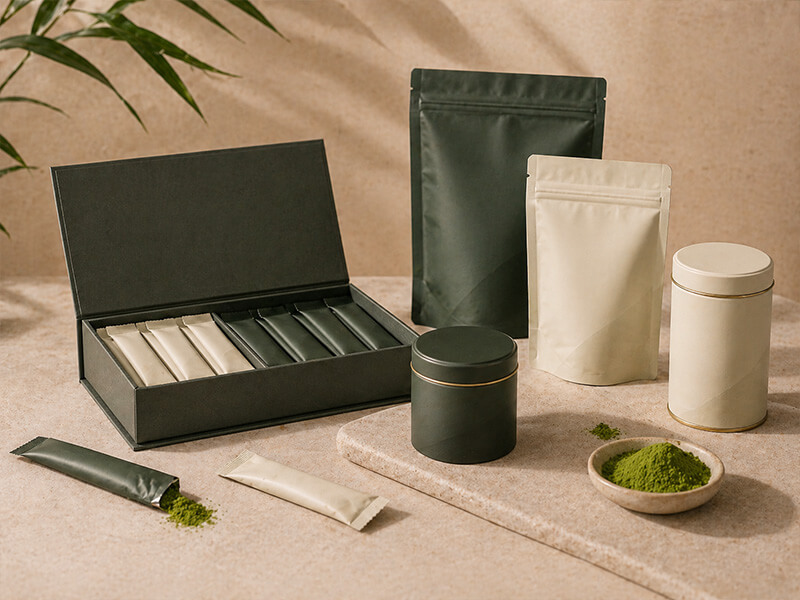
This is suitable for:
- Retail brands
- Amazon sellers
- E-commerce brands
- Wellness brands
- Premium food brands
- Gift set brands
Practical Comparison
| Item | Bulk Powder | Private Label Product |
|---|---|---|
| Packaging | Standard bags or cartons | Branded pouch, tin, sachet, or box |
| MOQ level | Usually lower | Usually higher |
| Lead time | Shorter | Longer |
| Cost structure | Powder + packing | Powder + packaging + filling + label |
| Best for | Commercial use and manufacturing | Retail launch and brand building |
How Packaging Affects MOQ
Packaging is often the biggest reason MOQ increases.
A buyer may only need 100kg of matcha powder, but if they want custom printed pouches, the pouch supplier may require a much larger minimum quantity. This can make the overall project MOQ higher than expected.
Common Packaging Formats
| Packaging Format | MOQ Impact | Notes |
|---|---|---|
| Standard bulk foil bag | Lower | Suitable for cafés, foodservice, and ingredient use |
| Stock pouch with sticker label | Lower to medium | Good for small private label launches |
| Custom printed pouch | Medium to high | Better branding, but higher packaging MOQ |
| Tin can | Medium to high | Good for premium retail, but packaging cost is higher |
| Stick pack or sachet | Higher | Requires film, filling line setup, and sealing test |
| Gift box or kit | Higher | Multiple components increase MOQ and lead time |
For new brands, a practical first step is often to use stock packaging with custom labels. This allows you to test the market before investing in fully printed packaging.
How Grade Affects MOQ
MOQ may also vary by matcha grade.
Higher-grade matcha may have limited availability, especially when buyers require a specific color, taste profile, origin, or organic certification. Lower or commercial grades may be easier to source in larger quantities.
Grade and MOQ Planning
| Matcha Grade | MOQ Consideration |
|---|---|
| Ceremonial grade | May have limited batch availability and higher cost |
| Latte grade | Suitable for cafés and beverage brands; MOQ depends on supply plan |
| Culinary grade | Often practical for bakery and food manufacturing |
| Ingredient grade | Suitable for larger-volume commercial use |
| Organic matcha | MOQ may depend on certified raw material availability |
| Custom blend | MOQ is usually higher because it requires separate batching |
The key is not to ask only, “What is your MOQ?”
A better question is, “What is the MOQ for the grade suitable for my application?”
How MOQ Affects Unit Cost
MOQ and price are closely connected. Smaller orders usually have a higher unit cost, while larger orders may reduce the cost per kilogram or per finished unit.
Why Small Orders Cost More
Small orders often include the same basic work as larger orders:
- Communication
- Sample review
- Packing setup
- Label checking
- Quality control
- Document preparation
- Carton packing
- Export handling
When these costs are spread over a smaller quantity, the unit cost becomes higher.
Why Larger Orders Can Be More Cost-Effective
Larger orders may help reduce:
- Packaging cost per unit
- Labor cost per unit
- Freight cost per kilogram
- Production setup cost per unit
- Handling cost per carton
However, larger MOQ is not always better. Buyers should also consider storage, cash flow, freshness, and sales speed.
How to Choose the Right MOQ for Your Business
The right MOQ should match your business stage and sales plan.
For New Brands
If you are launching a new product, avoid starting too large unless you already have proven demand. Smaller MOQ, stock packaging, and sample testing can reduce risk.
Focus on:
- Testing customer response
- Confirming flavor and grade
- Validating packaging design
- Collecting market feedback
- Avoiding excessive inventory
For Growing Brands
If you already have sales data, you can plan MOQ based on repeat order cycles.
Focus on:
- Monthly sales volume
- Reorder timing
- Storage capacity
- Packaging improvement
- Cost reduction
For Distributors
Distributors usually need better unit pricing and stable supply. A larger MOQ may make sense if you have existing customers or sales channels.
Focus on:
- Regional demand
- Margin structure
- Warehouse planning
- Repeat supply
- Grade variety
For Cafés and Foodservice Buyers
Cafés should choose an MOQ that supports daily operation without creating freshness problems.
Focus on:
- Monthly drink volume
- Storage conditions
- Staff handling
- Packaging convenience
- Consistent taste and color
MOQ Planning Formula for B2B Buyers
A simple way to estimate MOQ is to start from your monthly usage.
For Cafés
Monthly Matcha Usage = Average matcha per drink × Drinks sold per day × Working days per month
Example:
3g matcha per drink × 80 drinks per day × 26 days = 6.24kg per month
In this case, a café may not need a very large first order. It may be better to start with a practical quantity and reorder regularly.
For Private Label Brands
Required Matcha Powder = Net weight per unit × Number of finished units
Example:
100g per pouch × 1,000 pouches = 100kg matcha powder
But you also need to consider packaging MOQ. If the printed pouch MOQ is 3,000 pieces, your packaging decision may change the total project plan.
For Food Manufacturers
Production Matcha Need = Matcha percentage in formula × Total finished product output
Example:
2% matcha in formula × 5,000kg finished product = 100kg matcha powder
This helps food manufacturers calculate MOQ based on real production demand instead of guessing.
MOQ Questions to Ask Before Ordering
Before placing a matcha order, ask your supplier these questions:
| Question | Why It Matters |
|---|---|
| What is the MOQ for bulk powder? | Helps you understand the base order quantity |
| What is the MOQ for private label packaging? | Prevents packaging surprises |
| Can I use stock packaging for the first order? | Reduces launch risk |
| Does the MOQ change by grade? | Helps match product quality with budget |
| Does organic matcha have a different MOQ? | Important for certified products |
| Can different grades be combined in one order? | Useful for distributors or multi-product brands |
| What is the lead time at this MOQ? | Helps you plan launch timing |
| Can the same grade be supplied for repeat orders? | Supports long-term supply stability |
| What quantity gives better pricing? | Helps compare cost levels |
| What packaging option is best for a first order? | Helps balance branding and budget |
Common MOQ Mistakes B2B Buyers Should Avoid
Mistake 1: Only Asking for the Lowest MOQ
The lowest MOQ may not give you the best unit cost, packaging option, or long-term supply support. It may be useful for testing, but not always ideal for scaling.
Mistake 2: Ignoring Packaging MOQ
Many buyers focus only on matcha powder MOQ and later discover that printed pouches, tins, or sachets have a much higher MOQ.
Mistake 3: Choosing Custom Packaging Too Early
Fully custom packaging is attractive, but it may increase MOQ, cost, and lead time. For a first launch, stock packaging with custom labels may be more practical.
Mistake 4: Ordering Too Much Before Testing
Bulk ordering before sample testing can create serious problems if the grade does not perform well in your actual product.
Mistake 5: Not Planning Reorders
A first order should not be planned alone. Buyers should also consider how quickly they can reorder and whether the same grade will remain available.
Mistake 6: Comparing MOQ Without Comparing What Is Included
One supplier’s MOQ may include standard packaging and documents, while another may only include raw powder. Always compare the full offer.
How MOQ Connects with Lead Time
MOQ can also affect production and delivery timing. A small stock order may be ready quickly, while a private label order may take longer because packaging and labeling need extra time.
Typical Timeline Factors
| Project Type | Main Time Factors |
|---|---|
| Bulk powder order | Stock availability, packing, inspection |
| Private label pouch | Label design, pouch preparation, filling |
| Printed packaging | Artwork approval, printing, packing |
| Tin packaging | Tin sourcing, label or printing work |
| Stick pack | Film preparation, filling line setup, sealing test |
| Custom blend | Formula confirmation, sample approval, production |
A good supplier should explain both MOQ and lead time clearly. If only the MOQ is clear but the production timeline is vague, the project may become difficult to manage.
How to Negotiate MOQ with a Matcha Supplier
MOQ is not always impossible to discuss, especially when the buyer has a clear plan.
What Helps MOQ Negotiation
Suppliers are more likely to support flexible MOQ if you can provide:
- Clear application
- Target quantity
- Packaging preference
- Expected repeat order plan
- Target market
- Grade requirement
- Timeline
- Artwork status if private label
- Shipping method or forwarder information
Practical Ways to Reduce First-Order MOQ
You may ask whether the supplier can support:
- Stock packaging instead of printed packaging
- Label stickers instead of fully custom bags
- Fewer SKUs for the first order
- One grade for multiple applications
- Bulk powder first, private label later
- Shared packaging size
- Samples before committing to larger MOQ
The goal is not always to push the MOQ as low as possible. The better goal is to create a launch plan that is realistic for both buyer and supplier.
Matcha MOQ Decision Checklist
Use this checklist before confirming your order.
| Area | What to Confirm |
|---|---|
| Application | What product are you making? |
| Grade | Which matcha grade fits the application? |
| Quantity | How much matcha do you really need? |
| Packaging | Bulk bag, pouch, tin, sachet, or custom pack? |
| Powder MOQ | What is the minimum powder quantity? |
| Packaging MOQ | What is the minimum packaging quantity? |
| Unit cost | How does price change by quantity? |
| Lead time | How long does production and packing take? |
| Storage | Can you store the quantity properly? |
| Reorder plan | Can the supplier support repeat orders? |
| Documents | Are COA and specifications available? |
| Risk level | Is this a test launch or established product? |
How MatchaOEMFactory Supports Flexible Matcha MOQ Planning
MatchaOEMFactory helps B2B buyers plan matcha MOQ based on application, packaging format, launch stage, and long-term supply needs.
We support cafés, distributors, food and beverage brands, supplement companies, and private label businesses with bulk matcha powder, wholesale supply, private label packaging, custom matcha solutions, and export-ready documentation.
For new projects, we can help buyers compare different grades, test samples, choose practical packaging, and start with a sourcing plan that fits the business stage. For growing brands and distributors, we can support larger-volume supply, repeat orders, and more cost-effective packaging options.
Instead of treating MOQ as just a number, we help buyers understand how MOQ connects with price, packaging, lead time, and future growth.
FAQ
What is the MOQ for bulk matcha powder?
Bulk matcha powder MOQ depends on the supplier, grade, packaging, and stock availability. Standard bulk packaging usually has a lower MOQ than private label or custom packaging.
Why is private label matcha MOQ higher than bulk powder MOQ?
Private label MOQ is usually higher because it involves packaging materials, label preparation, filling, sealing, carton packing, and sometimes custom printing.
Can I start with a small MOQ for a new matcha brand?
In many cases, yes. New brands can often start with stock packaging, label stickers, or limited SKUs before moving into fully customized packaging.
Does organic matcha have a higher MOQ?
Organic matcha may have a different MOQ because certified raw materials, traceability, and documentation need to be managed separately.
Can MOQ be reduced if I order several matcha grades?
Sometimes, but it depends on the supplier’s stock, production plan, and packaging requirements. It is better to ask whether mixed-grade orders are possible.
What is more important: low MOQ or low price?
It depends on your business stage. New brands may care more about lower MOQ and flexibility, while distributors and established brands may care more about lower unit cost and stable supply.
Ready to Plan the Right Matcha MOQ for Your Business?
Choosing the right matcha MOQ can help you control cost, reduce inventory risk, and build a smoother launch or sourcing plan.
MatchaOEMFactory supports B2B buyers with bulk matcha powder, wholesale supply, private label packaging, custom matcha solutions, sample testing, and export-ready documentation.
Share your application, target market, expected quantity, and packaging needs. Our team can help you compare suitable matcha grades and prepare a practical MOQ plan for your project.
Request Matcha Samples | Get a MOQ-Based Quote | Discuss Your Packaging Plan