
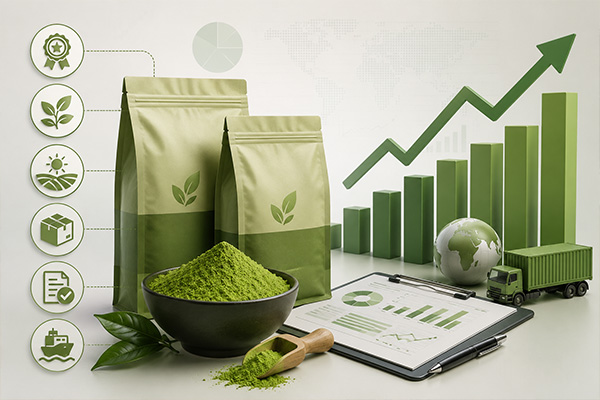
Bulk matcha prices can vary widely from one supplier to another. For B2B buyers, this can be confusing: one supplier may quote a much lower price, while another may offer a higher price for what seems to be the same green tea powder.
In reality, matcha cost is affected by many factors, including grade, origin, color, flavor, processing method, fineness, certification, testing, packaging, order quantity, and logistics. For cafés, distributors, food and beverage brands, supplement companies, and private label businesses, understanding these factors helps you compare quotes more accurately and avoid choosing the wrong product based only on price.
This guide explains what affects bulk matcha cost and how B2B buyers can evaluate price in a more practical way.
Why Bulk Matcha Prices Are Not All the Same
When buyers search for bulk matcha powder, they often compare price per kilogram first. That is useful, but it does not tell the whole story.
Two matcha powders may look similar in a photo but perform very differently in real applications. One may stay bright in a latte, while another turns dull after mixing with milk. One may work well in bakery products, while another loses color after heating. One may include batch documents and packaging support, while another only offers raw powder.
What the price usually reflects
Bulk matcha cost may reflect:
- Raw material quality
- Harvest season
- Shade-growing level
- Color and taste profile
- Grinding method and powder fineness
- Grade positioning
- Organic or conventional status
- Testing and documentation
- Packaging format
- Order quantity
- Private label requirements
- Export and logistics support
That is why a lower price is not always cheaper in the long term. If the matcha does not fit your product, you may lose more through reformulation, complaints, color instability, or delayed launches.
Cost Factor 1: Matcha Grade and Application
Grade is one of the biggest factors affecting matcha price. Higher-grade matcha usually requires better raw leaves, more careful processing, finer texture, and stronger sensory quality.
However, the highest grade is not always the best commercial choice. B2B buyers should choose matcha based on application, not only grade name.
Common grade-price relationship
| Matcha Type | Typical Use | Price Position | Buyer Consideration |
|---|---|---|---|
| Ceremonial grade matcha | Traditional drinking, premium retail | Higher | Smooth taste, fine texture, bright color |
| Latte grade matcha | Cafés, milk-based drinks, beverage menus | Medium to high | Color, milk compatibility, balanced bitterness |
| Culinary grade matcha | Bakery, desserts, ice cream, chocolate | Medium | Flavor strength, heat performance, cost control |
| Ingredient grade matcha | Food manufacturing, blends, supplements | Lower to medium | Formula performance, bulk efficiency |
| Organic matcha | Organic retail, clean-label brands | Higher | Certification, traceability, document review |
For cafés, a well-selected Latte Grade Matcha may perform better than ceremonial matcha because it needs enough flavor strength to stand out in milk. For bakery and desserts,Culinary Matcha may be more cost-effective than premium drinking-grade matcha. For food manufacturing and supplement blends, Ingredient Grade Matcha can be a practical option when color, testing, and consistency meet the product requirement.
Cost Factor 2: Color, Taste, and Sensory Quality
Color is one of the most visible reasons why matcha prices differ. Brighter green matcha often costs more because it usually requires better raw material selection and careful processing.
But color should not be judged alone. A good commercial matcha should also have the right taste, aroma, and texture for its final use.
H3: Color value by application
For different buyers, color has different commercial value:
- Café drinks need bright green visual appeal in cups and social media photos.
- Private label brands need attractive powder color for product presentation.
- Bakery brands need color that can remain visible after processing.
- RTD beverage brands need color stability over time.
- Supplement brands may care more about clean-label positioning and ingredient consistency.
H3: Taste value by application
Taste also affects cost. A smoother, more umami matcha is usually more expensive than a stronger, more bitter matcha. But in milk-based drinks or baked goods, a slightly stronger matcha flavor may be more practical.
That means buyers should not simply ask for “the greenest” or “the smoothest” matcha. The better question is:
Which color and taste profile works best for my product and price point?
Cost Factor 3: Origin and Supply Chain Control
Origin can affect matcha price, but it should not be the only factor buyers compare.
Some buyers focus heavily on whether matcha is from China or Japan. Origin can influence taste profile, cost, market positioning, and buyer perception. However, for B2B use, processing quality, grade selection, freshness, testing, and application performance are just as important.
H3: Why origin affects cost
Origin may affect cost because of:
- Tea-growing region
- Raw leaf quality
- Labor and processing cost
- Export cost
- Brand perception
- Certification availability
- Supply volume
- Currency and logistics factors
H3: Why supply chain control matters more than origin alone
A supplier with stronger supply chain control can often provide better batch consistency, clearer documents, and more reliable repeat orders. This matters for buyers who need stable menu quality, retail product consistency, or long-term wholesale supply.
Cost Factor 4: Processing Method and Powder Fineness
Processing also affects matcha cost. The way tea leaves are processed, dried, ground, and packed can influence color, flavor, texture, and application performance.
For buyers, powder fineness is especially important. Finer matcha can improve mouthfeel, mixing performance, and visual smoothness. Coarser powder may cost less but can create problems such as gritty texture, sediment, or weaker product appearance.
H3: Processing details that can influence price
Important processing-related factors include:
- Leaf selection
- Steaming or fixation method
- Drying control
- Stems and veins removal level
- Grinding method
- Mesh size
- Moisture control
- Final packing environment
H4: Why fineness matters commercially
Fineness matters differently depending on the application:
| Application | Why Fineness Matters |
|---|---|
| Matcha latte | Smoother texture and better drinking experience |
| RTD beverage | Better suspension and less visible sediment |
| Bakery | More even color distribution |
| Supplement powder | Better blending with other ingredients |
| Retail pouch | Better perceived quality when customers prepare drinks |
If a supplier offers a very low price, buyers should check whether the powder fineness is suitable for their product.
Cost Factor 5: Organic Certification and Food Safety Systems
Organic matcha usually costs more than conventional matcha because certification, farm management, documentation, traceability, and compliance review add cost to the supply chain.
For B2B buyers, organic cost should be judged together with market positioning. If your customers are organic retailers, premium wellness brands, or clean-label food buyers, organic matcha may support a higher product value. If your product is mainly for café drinks or bakery manufacturing, conventional matcha may be more cost-effective.
Organic certification affects both cost and documentation
For the U.S. market, USDA organic labeling has clear requirements. USDA states that products sold, labeled, or represented as organic must meet organic content and labeling rules, and organic product labels must be reviewed and approved by a USDA-accredited certifying agent before marketplace use.
For the EU market, the European Commission explains that the EU organic logo must appear with the code number of the control body and the place where the agricultural raw materials were farmed.
Food safety certification may also affect price
Food safety systems can also influence supplier cost. ISO explains that ISO 22000 sets out requirements for a food safety management system and can be used by organizations across the food chain.
Cost Factor 6: Testing, COA, and Documentation
Testing and documentation can also affect matcha cost. Some buyers only ask for product photos and price, but serious B2B buyers usually need documentation for import, internal review, retail listing, or customer assurance.
Common documents that may influence cost
Documents and tests may include:
COA
Product specification sheet
Microbiological information
Heavy metal information
Pesticide residue information
Moisture level
Shelf life and storage conditions
Organic certificate, if applicable
Export invoice and packing list
Extra third-party testing may increase cost, but it can reduce risk for brands selling to stricter markets or larger retail customers.
Document quality also matters
Not all documents have the same value. Buyers should check whether:
- The COA matches the actual batch
- The specification matches the grade being purchased
- Certificates are valid and current
- Organic scope covers the product being sold
- Test items meet your market or customer requirement
Cost Factor 7: Packaging Format
Packaging is another major reason why bulk matcha prices differ. A quote for raw bulk powder is not the same as a quote for private label pouches, tins, sachets, or retail-ready products.
H3: Packaging cost by format
| Packaging Format | Cost Impact | Best For |
|---|---|---|
| 1kg aluminum foil bag | Lower to medium | Cafés, foodservice, small wholesale |
| 5kg / 10kg bulk carton | Lower per kg | Food manufacturers, distributors |
| Stand-up pouch | Medium | Private label and retail brands |
| Tin can | Medium to high | Premium retail and gifting |
| Stick pack / sachet | Higher | Convenience, samples, single-serving products |
| Custom printed packaging | Higher | Brand launch and retail positioning |
H3: Why packaging affects more than price
Packaging affects:
- Shelf life
- Moisture protection
- Oxygen exposure
- Product appearance
- Retail presentation
- Shipping volume
- MOQ
- Lead time
For new brands, stock packaging with labels may be more flexible. For established brands, custom printed packaging can improve brand presentation but may require higher MOQ and longer production time.
Cost Factor 8: MOQ and Order Quantity
Bulk matcha pricing is closely connected to MOQ and order quantity. Larger orders often have better unit pricing because production, packing, documentation, and handling costs can be spread across more units.
However, lower MOQ can be valuable for new brands because it reduces inventory pressure and allows market testing.
H3: How MOQ affects price
| Order Situation | Price Effect | Buyer Consideration |
|---|---|---|
| Small trial order | Higher unit price | Good for testing and market validation |
| Standard bulk order | More balanced pricing | Suitable for repeat B2B purchasing |
| Large volume order | Lower unit cost | Requires demand certainty and storage planning |
| Custom packaging order | Higher setup cost | MOQ may come from packaging supplier |
| Organic matcha order | Often higher cost | Certification and traceability matter |
H3: Why lowest MOQ is not always best
A very low MOQ may come with:
- Higher price per kg
- Limited packaging options
- Less flexibility in grade selection
- Less stable repeat supply
- Higher shipping cost per unit
The best MOQ is not always the smallest MOQ. It should match your launch plan, storage capacity, sales forecast, and cash flow.
Cost Factor 9: Shipping Terms and Landed Cost
Many buyers compare only EXW or FOB product prices, but the real cost is the landed cost.
H3: What landed cost includes
Landed cost may include:
Product cost
Packaging cost
Export handling
Freight
Insurance
Import duties
Customs clearance
Local delivery
Storage
Additional testing or inspection
A supplier with a higher product price but better packing, clearer documents, and smoother export support may reduce hidden costs during import.
H4: Ask suppliers for comparable quotations
When comparing suppliers, ask for the same quotation basis:
- EXW price
- FOB price
- CIF price
- DDP estimate, if available
- Net weight and gross weight
- Carton dimensions
- Lead time
- Document list
Without the same quotation basis, price comparison can be misleading.
A Practical Bulk Matcha Cost Breakdown
The table below shows how different cost factors may influence the final price.
| Cost Factor | Price Impact | Why It Matters |
|---|---|---|
| Grade | High | Determines raw material level and sensory quality |
| Color | High | Affects visual appeal in drinks and retail products |
| Taste | Medium to high | Affects customer experience and product positioning |
| Fineness | Medium | Affects texture, mixing, and sediment |
| Organic certification | High | Adds certification and traceability requirements |
| Testing documents | Medium | Supports import, QA, and customer review |
| Packaging | Medium to high | Affects shelf life, branding, and MOQ |
| Order quantity | High | Larger orders usually reduce unit cost |
| Shipping terms | Medium to high | Determines real landed cost |
| Private label support | Medium to high | Adds design, packing, and project management cost |
How to Judge Whether a Matcha Price Is Reasonable
A reasonable bulk matcha price is not simply the lowest price. It is a price that matches the product’s quality, documents, packaging, and commercial use.
H3: Use these questions before accepting a quote
Ask yourself:
Does this grade fit my application?
Have I tested the sample in my real formula?
Does the bulk batch match the sample?
Are COA and specifications available?
Is the packaging included?
Is the MOQ realistic for my business?
Are shipping terms clear?
Can the supplier support repeat orders?
Is the price still good after landed cost?
H3: Compare cost per finished product
For cafés and manufacturers, it may be more useful to calculate cost per serving or cost per finished unit instead of only price per kilogram.
For example:
| Business Type | Better Cost Metric |
|---|---|
| Café | Cost per latte |
| Bakery | Cost per cookie, cake, or dessert unit |
| RTD beverage | Cost per bottle or can |
| Supplement brand | Cost per sachet, capsule serving, or pouch |
| Distributor | Gross margin per kg or carton |
| Private label brand | Cost per finished retail unit |
This makes price comparison more practical and easier to connect with your selling price.
Common Price Mistakes B2B Buyers Should Avoid
Mistake 1: Comparing different grades as if they are the same
A ceremonial-grade quote and an ingredient-grade quote are not comparable. Always confirm grade, color, taste, fineness, and application.
Mistake 2: Ignoring packaging cost
Bulk powder pricing may look attractive, but custom packaging can significantly affect total project cost.
Mistake 3: Forgetting certification cost
Organic-certified matcha usually costs more. If your market does not require organic positioning, conventional matcha may be more practical.
Mistake 4: Not calculating landed cost
The cheapest product price may not be cheapest after freight, duties, handling, delays, or repacking.
Mistake 5: Choosing price before testing samples
Always test samples in your real application before making a pricing decision.
How MatchaOEMFactory Helps Buyers Control Matcha Cost
MatchaOEMFactory supports B2B buyers with application-based matcha grade selection, bulk supply, private label packaging, and export-ready documentation.
We help customers control cost by matching the right grade to the right application. Instead of recommending the highest grade for every project, we help buyers choose a practical option based on product use, target market, packaging plan, and price positioning.
Our support includes:
- Bulk matcha powder supply
- Wholesale matcha options
- Ceremonial, latte, culinary, ingredient-grade, and organic matcha
- Sample testing support
- Private label packaging options
- Custom matcha blending
- COA and specification support
- Export-ready documentation
- Shipping and logistics coordination
FAQ
Why is some bulk matcha much cheaper than others?
Bulk matcha prices vary because of grade, raw material quality, color, taste, fineness, certification, testing, packaging, order quantity, and shipping terms.
Is expensive matcha always better?
Not always. Expensive matcha may be better for premium drinking or retail positioning, but it may not be necessary for bakery, RTD drinks, or food manufacturing.
What is the best matcha grade for cost control?
It depends on your application. Latte grade may be best for cafés, culinary grade for bakery, and ingredient grade for manufacturing or blends.
Does organic matcha cost more?
Usually yes. Organic matcha often involves certification, traceability, and documentation requirements, which can increase cost.
Should I compare matcha price by kilogram or finished product?
For B2B use, both matter. Price per kilogram is useful for supplier comparison, but cost per serving or finished unit is better for business planning.
How can I lower bulk matcha cost without lowering quality too much?
Choose the right grade for your application, test samples carefully, use practical packaging, plan order quantity, and compare landed cost instead of only product price.
Need a Bulk Matcha Quote for Your Project?
A good bulk matcha price should match your product application, quality expectations, packaging plan, and target market.
MatchaOEMFactory helps cafés, distributors, food and beverage brands, supplement companies, and private label businesses compare matcha grades, test samples, plan packaging, and control sourcing cost with practical B2B support.
Share your application, expected quantity, packaging needs, and target price range. Our team can recommend suitable matcha options and prepare a tailored quotation for your project.