
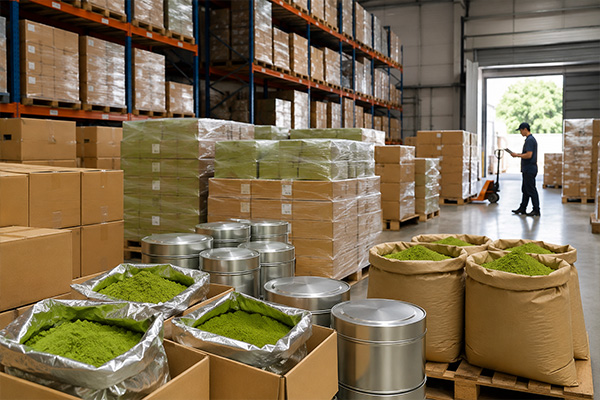
For distributors and wholesalers, matcha is not just a trending ingredient. It can become a repeatable B2B product category that serves cafés, beverage shops, food manufacturers, bakeries, retailers, private label brands, and wellness companies.
However, supplying matcha successfully is different from buying a few bags of green tea powder and reselling them. Distributors need a product structure that is easy to explain, stable to reorder, profitable to stock, and flexible enough to serve different customer groups.
A café may need latte-grade matcha in 1kg bags. A bakery may need culinary matcha in larger bulk packs. A premium retailer may want ceremonial matcha in tins or small pouches. A wellness brand may ask for organic matcha with documentation. If a distributor cannot organize these needs clearly, matcha supply can become confusing and difficult to scale.
This guide explains how distributors and wholesalers can build a practical matcha supply program, choose the right product range, manage inventory, support customers, and work with a reliable B2B matcha supplier.
Why Matcha Is a Good Category for Distributors
Matcha is useful for distributors because it can serve multiple customer groups with one ingredient category. Unlike a single finished consumer product, matcha can be sold in different grades, formats, and pack sizes depending on the buyer’s business model.
Distributors can supply matcha to:
- Cafés and coffee shops
- Bubble tea shops
- Bakery and dessert manufacturers
- Getränkemarken
- Foodservice businesses
- Organic and premium retailers
- E-commerce brands
- Private label companies
- Supplement and wellness brands
- Regional wholesalers
This makes matcha a flexible category with repeat-order potential.
A café may reorder monthly. A food manufacturer may reorder based on production batches. A retailer may reorder based on shelf sales. A private label brand may start small and grow into larger orders.
For distributors, the opportunity is not only selling matcha powder. The real opportunity is building a matcha supply system that customers can rely on.
Understand Your Customer Segments First
Before building a matcha catalog, distributors should divide customers by use case. This is more useful than only dividing products by grade.
Different customer types ask different questions.
A café asks:
Will this matcha look good in lattes?
Can I get the same taste every month?
Is the bag easy for baristas to use?
A bakery asks:
Will the color stay visible after baking?
Is the flavor strong enough in cookies and cakes?
Can I buy larger bags at a better cost?
A retailer asks:
Does the packaging look good on the shelf?
Is there a barcode and clear label?
Can customers understand the product quickly?
A private label brand asks:
Can we customize packaging?
Can we start with a practical MOQ?
Can you support samples and documents?
A distributor should not sell the same matcha message to every customer. The product explanation should match the buyer’s business.
Distributor Customer Segmentation Table
| Customer Type | Main Need | Best Matcha Supply Direction |
|---|---|---|
| Cafés and coffee shops | Daily latte consistency | Latte-grade matcha, 500g or 1kg packs |
| Bubble tea shops | Color and flavor in sweet drinks | Latte-grade or beverage-grade matcha |
| Bakeries | Heat-stable flavor and color | Culinary matcha, bulk bags |
| Lebensmittelhersteller | Production efficiency | Culinary or bulk ingredient matcha |
| Retailers | Shelf-ready products | 50g–100g pouches or tins |
| Organic stores | Certification and clean label | Organic matcha with documents |
| Private Label-Marken | Custom packaging | OEM / private label support |
| Wellness-Marken | Lifestyle positioning | Organic or premium matcha formats |
This segmentation helps distributors build a catalog that is easier to sell.
Build a Matcha Catalog with Clear Product Roles
A distributor does not need too many matcha products. In fact, too many similar SKUs can make sales harder.
A strong distributor catalog should usually include a few clear product roles.
Core Café Matcha
This is the product for cafés, coffee shops, beverage shops, and foodservice buyers.
Typical format:
1kg latte-grade matcha bag
This product should focus on:
- Color in milk
- Balanced taste
- Easy preparation
- Stable supply
- Practical cost per drink
Bakery and Food Manufacturing Matcha
This product is for bakeries, dessert companies, food factories, and manufacturers.
Typical format:
5kg or 10kg culinary matcha bag
This product should focus on:
- Strong flavor
- Heat performance
- Cost control
- Bulk packaging
- Production consistency
Premium Retail Matcha
This product is for retail shops, specialty tea stores, gift channels, and premium e-commerce.
Typical formats:
30g tin
50g pouch
100g pouch
This product should focus on:
- Appearance
- Smooth taste
- Premium packaging
- Shelf appeal
- Clear customer education
Organic Matcha Option
This product is for organic retailers, wellness brands, clean-label buyers, and premium food brands.
Typical formats:
Organic matcha pouch
Organic bulk matcha
Organic private label option
This product should focus on:
- Certification
- Rückverfolgbarkeit
- Dokumente
- Clean-label positioning
- Higher value customers
Sample and Trial Kit
This is especially useful for distributors because many customers want to test before ordering.
A sample kit may include:
Latte-grade sample
Culinary sample
Ceremonial sample
Organic sample
Application guide
Quotation sheet
This can help the distributor convert inquiries into orders more efficiently.
Recommended Matcha Supply Portfolio for Distributors
A practical first catalog may look like this:
| Product | Format | Target Buyer | Role |
|---|---|---|---|
| Latte Matcha | 1kg bag | Cafés and beverage shops | Main repeat seller |
| Culinary Matcha | 5kg bag | Bakeries and food manufacturers | Bulk production SKU |
| Premium-Matcha | 50g / 100g pouch | Retailers and e-commerce | Shelf-ready product |
| Bio-Matcha | 100g pouch or bulk bag | Organic and wellness buyers | Premium option |
| Sample Kit | Small sample packs | New leads | Sales conversion tool |
This structure is simple enough to manage but flexible enough to serve multiple customer groups.
The distributor can expand later into sachets, tins, starter kits, or private label projects after demand is clear.
Make Your Catalog Easy for Sales Teams to Explain
A distributor’s sales team should not need to be matcha experts to sell matcha well. The product line should be easy to explain.
Instead of using only grade names, create sales-friendly product descriptions.
Example Sales Positioning
| Product Name | Simple Explanation |
|---|---|
| Café Latte Matcha | Best for cafés making hot and iced matcha lattes |
| Bakery Matcha | Best for cookies, cakes, desserts, and food production |
| Premium-Matcha | Best for retail pouches, tins, and drinking matcha |
| Bio-Matcha | Best for organic, wellness, and clean-label buyers |
| Matcha Sample Kit | Best for customers who need to compare before ordering |
This makes the catalog easier for sales teams, customers, and purchasing managers.
What a Distributor Sales Sheet Should Include
A good product sheet should show:
- Product name
- Grade or quality level
- Recommended application
- Pack size
- MOQ
- Haltbarkeit
- Lagerbedingungen
- Available documents
- Suggested customer type
- Reorder lead time
- Sample availability
Distributors should avoid sending only a price list. A practical product sheet can help customers make decisions faster.
Use Samples as a Sales Tool
For distributors, samples are not only a cost. They are a sales tool.
Many customers will not place a matcha order until they test:
- Farbe
- Geschmack
- Aroma
- Milk performance
- Baking performance
- Textur
- Packaging quality
A well-organized sample program can make the distributor look more professional.
Sample Kit Ideas
| Sample Kit Type | Geeignet für | What to Include |
|---|---|---|
| Café Sample Kit | Cafés and coffee shops | 2–3 latte-grade samples |
| Bakery Sample Kit | Bakeries and dessert brands | Culinary matcha samples |
| Retail Sample Kit | Retailers and e-commerce | Pouch or tin mockup + product sample |
| Organic Sample Kit | Organic and wellness buyers | Organic matcha sample + certificate info |
| Full Distributor Kit | Regional wholesalers | Multiple grades + application guide |
What to Send with Samples
Do not send matcha samples alone. Include practical support materials:
- Suggested usage
- Application recommendation
- Storage instructions
- Product comparison sheet
- Quotation by quantity
- Available packaging options
- COA or specification summary
This helps the buyer test properly and reduces back-and-forth communication.
Plan Inventory by Customer Type
Inventory planning is one of the biggest challenges for distributors. If you stock the wrong format, cash is tied up in slow-moving products. If you stock too little, you may lose repeat customers.
Instead of stocking everything, distributors should classify inventory into three groups.
Fast-Moving Inventory
These are products with frequent repeat orders.
Examples:
- 1kg latte-grade matcha for cafés
- 5kg culinary matcha for food production
- 100g retail pouch for stores
These products should have stable stock.
Strategic Inventory
These products may not move as fast but help you serve higher-value customers.
Examples:
- Bio-Matcha
- Ceremonial matcha
- Premium tins
- Private label-ready packaging options
These should be managed carefully based on demand.
Custom Order Products
These should not always be stocked in large quantities.
Examples:
- Fully printed private label packaging
- Special blends
- Seasonal gift boxes
- Stickpackungen
- Large custom orders
These are better produced after customer confirmation.
Inventory Planning Table
| Inventory Type | Product Example | Stocking Strategy |
|---|---|---|
| Fast-moving | 1kg latte-grade matcha | Keep regular stock |
| Fast-moving | 5kg culinary matcha | Stock based on manufacturer demand |
| Strategic | Bio-Matcha | Stock smaller quantity or confirm demand |
| Strategic | Premium ceremonial matcha | Stock for retail customers |
| Custom | Private label packaging | Produce after order confirmation |
| Custom | Seasonal gift set | Plan by campaign |
This prevents distributors from overstocking too many slow-moving SKUs.
Protect Matcha Quality in Warehousing
Matcha is sensitive to storage conditions. Distributors must protect product quality after receiving stock.
Poor warehouse handling can cause:
- Color fading
- Aroma loss
- Clumping
- Moisture absorption
- Shorter shelf life
- Customer complaints
Matcha Warehouse Storage Rules
Distributors should store matcha:
- In a cool, dry warehouse
- Away from direct sunlight
- Away from heat sources
- Away from strong odors
- In sealed cartons or bags
- With clear batch identification
- Using first-in, first-out stock rotation
Batch Control Matters
Each carton or pallet should be easy to identify.
Important records include:
- Product name
- Klasse
- Batch number
- Production date
- Expiry or best-before date
- Quantity received
- Quantity shipped
- Customer allocation
This helps distributors manage quality concerns and reorder planning.
Suggested internal links:
How to Store Matcha Powder Properly
Matcha Shelf Life Guide for B2B Buyers
Analysenzertifikat für Matcha-Pulver: Worauf Käufer achten sollten
Build a Pricing Structure for Wholesale Customers
Distributors usually serve different customer sizes. A small café, a regional chain, and a food manufacturer should not always receive the same pricing structure.
Common Wholesale Pricing Levels
| Buyer Type | Pricing Approach |
|---|---|
| Small café | Standard wholesale price |
| Café chain | Tiered price by monthly volume |
| Bakery manufacturer | Bulk price by carton or kg |
| Retail store | Case price by units |
| Distributor partner | Larger volume tier |
| Private label customer | Project-based quotation |
A clear price structure helps protect margin and encourages larger orders.
Consider Total Margin, Not Only Product Markup
When setting distributor pricing, include:
- Product cost
- Freight
- Import duties
- Warehouse cost
- Sample cost
- Sales support
- Packaging cost
- Slow-moving inventory risk
- Payment terms
- Customer service cost
A product with a higher margin but slow turnover may not be better than a product with moderate margin and frequent repeat orders.
Help Customers Sell the Matcha
A distributor can create more value by helping customers use and sell the product.
This is especially important for cafés, retailers, and private label buyers who may not fully understand matcha.
Sales Support Materials for Cafés
Provide:
- Drink recipe suggestions
- Matcha latte preparation guide
- Dosage recommendation
- Storage instructions
- Menu ideas
- Cost-per-cup calculation support
Sales Support Materials for Retailers
Provide:
- Product description
- Usage instructions
- Shelf display suggestions
- Häufig gestellte Fragen
- Product comparison table
- Basic education about grades
Sales Support Materials for Food Brands
Provide:
- Application suggestions
- Bulk specification
- COA support
- Packaging information
- Sample testing guidance
Distributors who provide these materials can become more valuable than competitors who only sell product.
Distributor Growth Strategy: From Product Supply to Category Partner
The most successful distributors do not simply sell ingredients. They help customers build categories.
For matcha, that means helping customers answer:
- Which grade should we use?
- How should we price matcha drinks?
- What packaging size should we buy?
- How much should we order monthly?
- Can we create a private label matcha product?
- Can we launch a seasonal matcha menu?
- Can we expand from cafés into retail?
This gives distributors a stronger role and makes customers more likely to reorder.
Category Growth Path
| Stage | Distributor Role | Customer Outcome |
|---|---|---|
| Sample stage | Provide samples and guidance | Customer tests matcha |
| First order | Recommend suitable pack size | Customer launches product |
| Repeat order | Maintain supply consistency | Customer gains confidence |
| Expansion | Suggest new SKUs or formats | Customer grows category |
| Private label | Support branded products | Customer builds stronger margin |
This is how matcha becomes more than a one-time order.
Case Example: Building a Regional Matcha Distribution Program
A regional food distributor wanted to add matcha to its product catalog. At first, it planned to stock six different matcha grades, several pouch sizes, and multiple retail formats.
After reviewing its customer base, the distributor realized most demand came from three groups:
- Cafés
- Bakeries
- Small retail stores
Instead of stocking too many SKUs, it started with a focused catalog:
1kg latte-grade matcha for cafés
5kg culinary matcha for bakeries
100g retail pouch for stores
Sample kit for new customers
The distributor trained its sales team to explain each product by application instead of only by grade.
After three months, the café matcha became the fastest-moving SKU. The distributor then added organic matcha as a premium option and began offering private label packaging for selected customers.
This step-by-step approach helped the distributor reduce inventory risk and build matcha as a profitable category.
Common Mistakes Distributors Should Avoid
Mistake 1: Stocking Too Many Similar Matcha Products
Too many similar SKUs confuse sales teams and customers. Start with clear product roles.
Mistake 2: Selling Matcha Only by Grade Name
Many customers do not understand grade names. Explain matcha by application: café latte, bakery, retail, organic, private label.
Mistake 3: Ignoring Warehouse Conditions
Matcha quality can decline if stored poorly. Warehouse handling is part of the supply chain.
Mistake 4: Not Preparing Sample Kits
Samples help customers test and convert. A distributor without samples may lose serious buyers.
Mistake 5: Not Supporting Customer Education
Cafés and retailers may need recipes, preparation instructions, and product explanations. Support materials can increase reorder rates.
Mistake 6: Treating Private Label as a Separate Business
Private label can become a natural extension of wholesale supply. Some café and retail customers may later want branded matcha products.
How MatchaOEMFactory Supports Distributors and Wholesalers
MatchaOEMFactory supports distributors and wholesalers with practical matcha supply solutions for different customer groups.
We can help you build a supply program with:
- Latte-grade matcha for cafés and beverage shops
- Culinary matcha for bakeries and food manufacturers
- Ceremonial matcha for premium retail products
- Organic matcha for wellness and organic channels
- Bulk packaging options such as 1kg, 5kg, and 10kg formats
- Retail pouch and tin options for finished products
- Sample kits for customer testing
- Private label packaging support
- Unterstützung bei Konformitätsbewertung und Spezifikationen
- MOQ and reorder planning
- Exportfähige Dokumentation
- Stable repeat supply for long-term distribution
Our team can help distributors build a product structure that is easy to sell, practical to stock, and suitable for repeat B2B orders.
Häufig gestellte Fragen
What matcha products should a distributor start with?
A practical starting catalog may include 1kg latte-grade matcha for cafés, 5kg culinary matcha for bakeries, 100g retail pouches, and a sample kit for new customers.
Should distributors stock ceremonial matcha?
Yes, but usually as a premium or retail-focused SKU. For repeat B2B volume, latte-grade and culinary matcha may move faster.
How can wholesalers sell more matcha to cafés?
Offer latte-grade samples, preparation guidance, cost-per-cup suggestions, and practical 500g or 1kg packaging for daily café use.
How should distributors store matcha?
Matcha should be stored in a cool, dry place away from light, heat, moisture, and strong odors. Batch numbers and expiry dates should be tracked carefully.
Can distributors offer private label matcha?
Yes. Private label can be a valuable extension for café, retail, and e-commerce customers who want their own branded matcha products.
How can MatchaOEMFactory support wholesale matcha supply?
MatchaOEMFactory provides multiple matcha grades, bulk packaging, retail packaging, sample support, COA documents, private label options, and repeat-order supply planning.
Ready to Build a Matcha Supply Program for Your Customers?
A strong matcha distribution business needs more than a product list. It needs clear product roles, practical packaging, stable quality, sample support, customer education, and reliable repeat supply.
MatchaOEMFactory helps distributors and wholesalers build matcha supply programs for cafés, retailers, food manufacturers, private label brands, and wellness companies.
Share your target customer groups, preferred pack sizes, expected order volume, and market requirements. Our team can help you compare suitable matcha options and prepare a tailored wholesale quotation.