
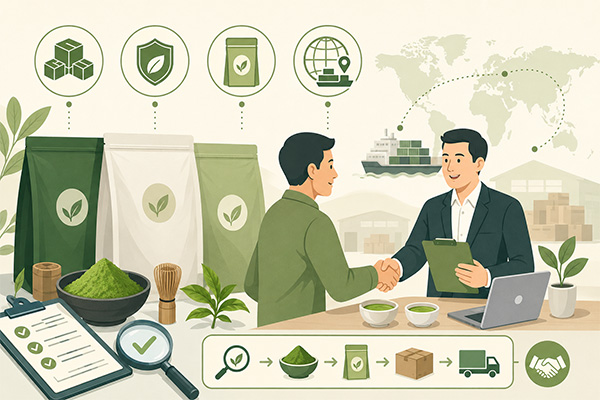
Choosing the right bulk matcha supplier is one of the most important decisions for cafés, beverage brands, food manufacturers, distributors, and private label businesses. A reliable supplier does more than offer matcha powder at a low price. They should help you choose the right grade, maintain stable quality, provide export-ready documents, support packaging needs, and deliver consistent supply for your business.
Whether you are sourcing matcha for lattes, bakery products, ready-to-drink beverages, supplement blends, or private label retail packs, this guide explains what B2B buyers should check before choosing a bulk matcha supplier.

Why Choosing the Right Bulk Matcha Supplier Matters
For B2B buyers, matcha is not just a tea powder. It is an ingredient that affects product color, taste, texture, cost, customer experience, and brand positioning.
A good bulk matcha supplier can help you:
- Select the right matcha grade for your application
- Maintain consistent color and flavor across batches
- Control cost without sacrificing quality
- Prepare documents for import and compliance
- Support private label or custom packaging
- Reduce sourcing risk and supply interruption
For example, a café chain may need a stable latte-grade matcha that performs well with milk, while a food manufacturer may need culinary or ingredient-grade matcha for baking, desserts, or large-scale production. A private label brand may need packaging support, label review, and export documents in addition to the powder itself.
If you are still comparing different product options, you can also review our Bulk Matcha Powder and Wholesale Matcha Powder to understand available supply formats.
1. Check Whether the Supplier Understands Your Application
The first question is not simply “How much is your matcha?”
A better question is:
“Which matcha grade is suitable for my product?”
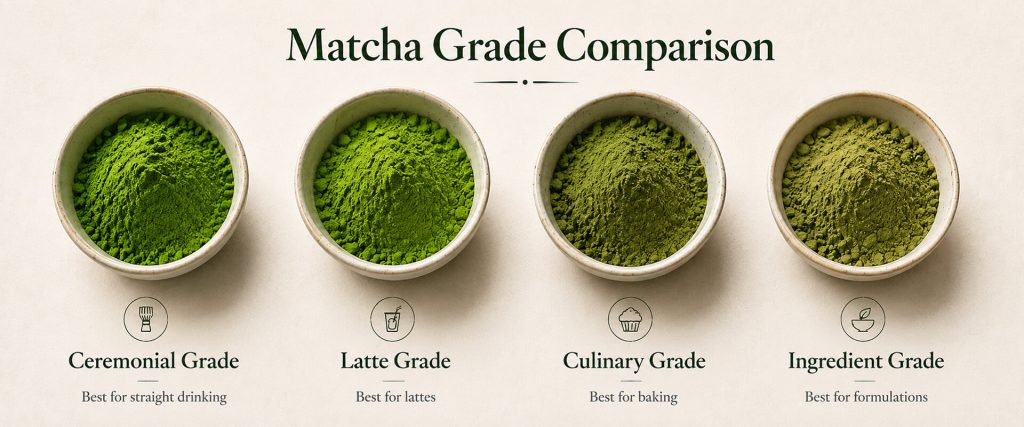
Different applications require different matcha characteristics:
| Aplicación | Recommended Matcha Type | Key Requirements |
|---|---|---|
| Café lattes | Matcha para café con leche | Bright color, balanced bitterness, good milk compatibility |
| Ceremonial drinks | Ceremonial matcha | Fine texture, smooth taste, strong aroma |
| Bakery and desserts | Culinary matcha | Stable color, stronger matcha flavor, cost efficiency |
| RTD beverages | Beverage or ingredient-grade matcha | Solubility, color stability, consistent taste |
| Suplementos | Ingredient-grade or organic matcha | Specification control, testing, clean-label positioning |
| Private label retail | Customized grade | Taste, packaging, branding, target market positioning |
A professional supplier should ask about your business model, target market, product format, order quantity, packaging type, and quality expectations before recommending a grade.
For more detailed grade selection, link this article to How to Choose the Right Matcha Grade for Your Product, Matcha ceremonial, Matcha de grado Latte, and Matcha culinario.
2. Evaluate Product Quality Beyond Color
Color is important, but it is not the only way to evaluate matcha quality. A bright green color can be a good sign, but B2B buyers should also check taste, aroma, fineness, moisture, batch consistency, and testing documents.
When evaluating bulk matcha quality, pay attention to:
- Color: vibrant green is usually preferred for drinks and premium products
- Aroma: fresh, grassy, roasted, or seaweed-like notes depending on grade
- Taste: balance between umami, bitterness, and astringency
- Texture: fine powder helps improve mouthfeel and suspension
- Performance: behavior in water, milk, baking, or manufacturing
- Stability: whether color and flavor remain consistent across batches
A good supplier should be able to provide samples before bulk ordering. You should test the sample in your real application, not only by drinking it with water.
For example, if you are buying matcha for cafés, test it in hot lattes, iced lattes, and plant-based milk. If you are buying for bakery products, test it under heat and fat-containing formulas. If you are buying for RTD beverages, test suspension, color change, and sedimentation.
3. Ask for COA, Specification Sheet, and Testing Information
For B2B orders, documents are just as important as samples. A reliable bulk matcha supplier should be able to provide documentation such as:
- COA
- Ficha técnica del producto
- Microbiological test information
- Heavy metal test information
- Información sobre residuos de plaguicidas
- Certificado ecológico, si procede
- Especificaciones del embalaje
- Vida útil y condiciones de conservación
- Export documents such as invoice and packing list
A COA helps buyers understand key quality and safety indicators for a specific batch. For imported food products, buyers may also need to check local import requirements. For example, the U.S. FDA requires prior notice for food imported or offered for import into the United States, unless an exemption applies.
For organic matcha, the supplier should also clarify which organic standard applies. USDA explains that organic certification verifies that a farm or handling facility complies with USDA organic regulations and allows the product to be sold, labeled, or represented as organic. The EU organic logo can only be used on products certified as organic by an authorized control body, and EU rules also require specific labeling information such as the control body code.
4. Check Whether the Supplier Offers Stable Bulk Supply
One sample may look good, but the real test is whether the supplier can deliver stable quality over time.
For B2B buyers, especially distributors, café chains, beverage manufacturers, and private label brands, batch consistency is essential. A supplier should be able to explain:
- Where the matcha comes from
- How raw material is selected
- How batches are controlled
- How production capacity is managed
- How inventory and lead time are planned
- How quality is checked before shipment
If you only buy from a small trading company without clear supply control, the product may change from batch to batch. This can create problems for your menu, formula, packaging claims, and customer experience.
A stronger supplier should have stable sourcing channels, quality control procedures, and the ability to support repeat orders.
5. Compare MOQ, Price, and Total Cost
Bulk matcha price depends on many factors, including grade, origin, color, flavor, fineness, certification, packaging, quantity, and shipping method.
When comparing suppliers, do not only compare the unit price per kilogram. You should compare the total value:
| Factor de coste | Por qué es importante |
|---|---|
| Calidad del matcha | Higher grades usually cost more but may not be necessary for every application |
| Certification | Organic or special certifications can increase cost |
| Embalaje | Bulk bags, tins, pouches, or private label packs have different costs |
| MOQ | Lower MOQ may cost more per unit |
| Shipping | Air, sea, and express delivery affect total landed cost |
| Testing | Extra lab testing may increase cost but supports compliance |
| Consistency | Low price is risky if batches are unstable |
A professional supplier should help you choose a practical balance between quality and cost. For example, a café may not need ceremonial grade matcha for milk-based drinks, while a premium retail brand may need better color, taste, and packaging.
6. Review Packaging Options
Packaging affects freshness, shelf life, appearance, logistics, and brand positioning. Before choosing a bulk matcha supplier, ask what packaging options they can support.
Common B2B matcha packaging options include:
- 1kg aluminum foil bags
- 5kg or 10kg bulk cartons
- Bolsas verticales
- Retail tins
- Sobres o bolsitas
- Private label bags
- Custom gift sets or starter kits
For bulk storage, matcha should be protected from light, heat, moisture, and oxygen. For private label products, packaging also needs to match your brand positioning and local labeling requirements.
A supplier with packaging support can help you move from bulk powder sourcing to finished retail products.
7. Check Private Label and OEM Capabilities
If you plan to launch your own matcha brand, choose a supplier that can support more than bulk powder.
Private label and OEM capabilities may include:
- Matcha grade selection
- Custom blending
- Flavor development
- Packaging design support
- Label and packaging review
- Small batch sampling
- Bulk production
- Export-ready documents
- Logistics support
This is especially important for new brands that do not yet have a complete product development team. A supplier with OEM experience can help reduce development time and simplify communication.
8. Consider Export Experience and Logistics Support
For international B2B orders, the supplier should understand export packaging, shipping methods, documents, and communication with freight forwarders.
Before confirming a bulk order, ask:
- Can the supplier provide export cartons and pallet options?
- Can they work with your forwarder?
- Can they provide commercial invoice and packing list?
- Can they support air, sea, or express shipment?
- Do they understand destination market document requirements?
- Can they provide batch photos or inspection before shipping?
This is especially important for importers, distributors, and private label brands that need predictable delivery schedules.
9. Avoid Choosing a Supplier Based Only on Low Price
Low price can be attractive, but it may create hidden risks:
- Poor color
- Bitter taste
- Unstable batches
- Coarse powder
- Weak documentation
- Unclear origin
- Poor packaging
- Long or uncertain lead time
- No private label support
For commercial buyers, the right supplier should help protect your product quality, brand image, and long-term supply. In many cases, stable quality and reliable support are more valuable than the lowest unit price.
Bulk Matcha Supplier Evaluation Checklist
Before choosing a supplier, use this checklist:
| Artículo | What to Check |
|---|---|
| Product range | Ceremonial, latte, culinary, ingredient-grade, organic matcha |
| Application support | Café, beverage, bakery, supplement, private label |
| Samples | Whether samples are available before bulk order |
| Documentos | COA, specification sheet, certificates, export documents |
| Testing | Heavy metals, pesticides, microbiology, moisture |
| Embalaje | Bulk bags, cartons, pouches, tins, custom packaging |
| MOQ | Bulk powder MOQ and private label MOQ |
| Plazo de entrega | Sampling, production, packaging, shipping |
| Supply stability | Repeat order consistency and batch control |
| Communication | Fast response, clear quotation, export experience |
Questions to Ask Before Choosing a Bulk Matcha Supplier
Here are practical questions you can send to suppliers:
- Which matcha grade do you recommend for my application?
- Can you provide samples before bulk ordering?
- What is your MOQ for bulk matcha powder?
- What packaging options do you offer?
- Can you provide COA and specification sheet?
- Do you support organic-certified matcha?
- Can you support private label packaging?
- What is your normal production lead time?
- Can you work with my freight forwarder?
- How do you control batch consistency?
These questions help you compare suppliers more clearly and avoid decisions based only on price.
How MatchaOEMFactory Supports B2B Buyers
MatchaOEMFactory supplies bulk matcha powder, wholesale matcha, private label matcha, and custom matcha solutions for cafés, distributors, food and beverage brands, supplement brands, and OEM customers.
We support B2B buyers with:
- Multiple matcha grades for different applications
- Bulk supply and wholesale packaging
- Opciones de embalaje para marcas blancas
- Custom matcha product development
- Asistencia en materia de COA y especificaciones
- Organic matcha sourcing options
- Documentación lista para la exportación
- International shipping and logistics support
Whether you are developing a café drink menu, sourcing matcha for food manufacturing, launching a private label brand, or looking for a stable wholesale matcha supplier, our team can help you compare grades, test samples, and build a suitable sourcing plan.
Preguntas frecuentes
1. What is the best matcha grade for bulk buying?
The best grade depends on your application. Cafés usually need latte-grade matcha, food manufacturers often use culinary or ingredient-grade matcha, and premium retail brands may choose ceremonial or organic matcha.
2. How much bulk matcha should I order first?
For new buyers, it is better to test samples first and then start with a practical MOQ based on your product format, packaging needs, and launch plan.
3. Should I choose organic matcha?
Organic matcha is suitable for brands targeting organic markets, clean-label positioning, wellness products, or premium retail channels. However, it may have higher cost and document requirements.
4. What documents should I ask from a matcha supplier?
You should ask for COA, specification sheet, packaging information, shelf life, storage conditions, and relevant certificates if needed.
5. Can one supplier support both bulk matcha and private label packaging?
Yes, a supplier with OEM and private label experience can support bulk powder, packaging, label design, custom product development, and export documents.\
Looking for a reliable bulk matcha supplier for your business?
MatchaOEMFactory provides bulk matcha powder, wholesale matcha, private label packaging, custom matcha solutions, and export-ready documentation for cafés, distributors, food brands, wellness companies, and OEM customers.
Contacto our team to request samples, compare matcha grades, discuss packaging options, or get a customized quotation for your business.