
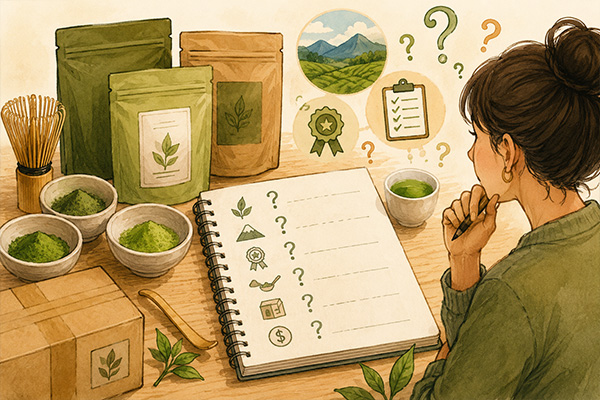
When businesses compare matcha suppliers, price is usually the first number they look at. That is understandable. For cafés, beverage brands, distributors, food manufacturers, and private label companies, ingredient cost directly affects margins.
But in matcha a granel sourcing, the cheapest quote is not always the best value.
A low price can hide many risks: unstable color, bitter taste, coarse powder, weak documentation, unclear origin, poor packaging, long lead times, or limited private label support. For B2B buyers, the better question is not simply “Who offers the lowest price?” It is:
“Which matcha supplier can support my product quality, business model, compliance needs, and long-term supply?”
This guide explains how to compare matcha suppliers beyond price, using a practical B2B evaluation approach.
The Problem with Comparing Matcha by Price Alone
A matcha quote usually gives you one visible number: price per kilogram. But that number does not show the full cost of using the product in your business.
For example, two suppliers may quote similar prices, but one supplier may provide better color stability, smoother taste, more reliable documents, faster response, and better packaging support. Another supplier may offer a lower price, but the powder may not perform well in lattes, may turn dull after baking, or may lack the documents needed for import.
What a low matcha price may not include
A low quote may not clearly show:
- Whether the matcha grade is suitable for your application
- Whether the sample quality matches the bulk order
- Whether the supplier can repeat the same quality next season
- Whether COA and specification sheets are available
- Whether packaging is food-safe and export-ready
- Whether organic certification is valid for your target market
- Whether the supplier understands private label or OEM needs
- Whether logistics and documentation support are included
For B2B buyers, these details can matter more than a small price difference.
Start with Total Value, Not Unit Price
A better way to compare matcha suppliers is to evaluate total sourcing value. This means looking at price together with quality, documents, packaging, service, consistency, and business fit.
A practical total value formula
You can think of supplier value like this:
Supplier Value = Product Fit + Quality Stability + Documents + Packaging Support + Communication + Long-Term Supply - Hidden Risk
This approach helps buyers avoid choosing a supplier that looks cheap at the beginning but becomes expensive later because of reformulation, customer complaints, import delays, or packaging problems.
Total value comparison table
| Evaluation Area | What to Compare | Por qué es importante |
|---|---|---|
| Application fit | Grade, flavor, color, solubility | Determines whether the powder works in your product |
| Batch stability | Color, taste, aroma, fineness | Protects repeat production and menu consistency |
| Documentación | COA, specification, certificates | Supports import, compliance, and buyer confidence |
| Packaging support | Bulk bags, pouches, tins, labels | Affects shelf life, branding, and logistics |
| Plazo de entrega | Sampling, production, shipping | Helps you plan launches and replenishment |
| Communication | Response speed and clarity | Reduces sourcing mistakes |
| Asistencia para marcas blancas | Design, packing, OEM options | Helps brands launch finished products |
| Long-term supply | Repeat order capability | Reduces supply interruption risk |
A supplier with a slightly higher price but stronger overall support may be more valuable than a low-cost supplier with limited control.
Compare Product Fit by Application
Not every matcha is suitable for every business. A supplier should be able to recommend matcha based on how you plan to use it.
For cafés and beverage shops
Cafés usually need matcha that performs well in milk-based drinks. The best option is not always the highest grade. A good café matcha should have:
- Bright green color after mixing
- Balanced bitterness
- Good performance in dairy and plant-based milk
- Strong enough flavor for iced drinks
- Stable quality for daily service
For food and beverage manufacturers
Food and beverage brands need matcha that performs well in real formulas, not just in a tasting bowl. For RTD drinks, bakery, ice cream, desserts, and snacks, buyers should test:
- Heat stability
- Color retention
- Flavor strength
- Sedimentation
- Compatibility with sugar, milk, fat, or other ingredients
- Coste por unidad terminada
For private label brands
Private label buyers need more than powder. They need a supplier who can support packaging, label information, sampling, production planning, and export documents.
Look at Quality Consistency, Not Only Sample Appearance
A supplier’s sample may look good, but B2B buyers should ask whether the same quality can be repeated in bulk orders.
What to check during sample evaluation
When comparing samples from different suppliers, test them under the same conditions:
| Test Area | What to Observe | Best Practice |
|---|---|---|
| Dry powder color | Green tone and brightness | Compare under natural light |
| Aroma | Freshness, grassy notes, roasted notes | Smell immediately after opening |
| Water test | Color, foam, bitterness | Use the same water temperature |
| Milk test | Color and flavor after mixing | Test dairy and plant-based milk |
| Application test | Baking, RTD, dessert, supplement blend | Test in your real formula |
| Textura | Smoothness and fineness | Check mouthfeel and visible particles |
| Stability | Color and taste over time | Observe after storage or processing |
A supplier who understands your testing method is more useful than one who only sends attractive photos.
Ask whether the bulk order will match the sample
Before confirming an order, ask the supplier:
Will the bulk order match this sample?
Is the sample from current stock or a previous batch?
Can you provide batch information?
Can you provide COA for the bulk batch?
How do you manage seasonal variation?
Check Documentation and Certification Carefully
Documents are often where serious B2B differences appear. Some suppliers can send a product photo and a price quickly, but cannot provide complete documents when the buyer needs them.
A professional supplier should be able to discuss documents early, especially if you are importing, distributing, selling organic products, or launching a private label brand.
Documents worth comparing
| Document | Por qué es importante |
|---|---|
| COA | Shows batch-related quality and test information |
| Specification sheet | Helps buyers understand product standards |
| Organic certificate | Supports organic claims when applicable |
| Información microbiológica | Important for food safety review |
| Información sobre los metales pesados | Important for buyer and import checks |
| Información sobre residuos de plaguicidas | Important for organic and export markets |
| Especificaciones del embalaje | Helps confirm shelf life and logistics |
| Commercial invoice / packing list | Needed for international shipping |
USDA explains that organic certification allows farms or processing facilities to sell, label, and represent products as organic, so buyers should not treat “organic” as a casual marketing word. For EU markets, the EU organic logo can only be used on products certified as organic by an authorized control agency or body.
If the supplier claims to have a food safety system, ask which standard applies and whether the certificate is current. ISO states that ISO 22000 sets out requirements for a food safety management system and can be used by organizations across the food chain.
Compare Packaging Support and Shelf-Life Thinking
Packaging is not just a container. For matcha, packaging affects color, aroma, shelf life, transport safety, and brand experience.
A supplier with strong packaging support should help you think through:
- Bulk powder packaging
- Foodservice packaging
- Private label pouch or tin options
- Label space and design layout
- Oxygen, light, moisture, and heat protection
- Carton packing
- Pallet or export packing
- Sample packaging versus mass production packaging
Packaging comparison by business type
| Tipo de empresa | Practical Packaging Option | Qué hay que confirmar |
|---|---|---|
| Café or foodservice | 500g / 1kg foodservice bags | Easy opening, resealing, storage |
| Distribuidor | Bulk cartons or larger bags | Carton strength, labels, batch marks |
| Marca de distribuidor | Printed pouches or tins | MOQ, artwork, barcode, label review |
| Marca de suplementos | Sachets, stick packs, blending packs | Powder flow, moisture control |
| Food manufacturer | 5kg / 10kg bulk packaging | Production handling and warehouse storage |
A low-price supplier may offer powder only, while a stronger B2B supplier can support your packaging plan from the start.
Evaluate Communication Quality
Communication is often underestimated. But in international sourcing, poor communication can become expensive.
Signs of a reliable supplier
A reliable supplier usually:
- Asks about your application before quoting
- Explains grade differences clearly
- Provides realistic MOQ and lead time
- Answers document questions directly
- Tells you what is possible and what is not
- Helps you compare options instead of pushing only one grade
- Confirms packaging details in writing
- Understands export and logistics communication
Signs to be careful
Be cautious if a supplier:
- Only talks about low price
- Avoids document questions
- Cannot explain the grade
- Sends unclear sample information
- Changes specifications often
- Gives unrealistic lead times
- Does not ask about your end product
- Uses vague terms like “best quality” without details
This is where price comparison becomes incomplete. A clear supplier can save weeks of back-and-forth communication.
Review MOQ, Lead Time, and Flexibility Together
MOQ should not be judged alone. A supplier may offer a low MOQ but higher unit cost, or a low price but a packaging MOQ that is too high for your launch plan.
Questions to ask about MOQ
Ask suppliers:
What is the MOQ for bulk powder?
What is the MOQ for private label packaging?
Can we start with stock packaging and label stickers?
Does the MOQ change for organic matcha?
What is the lead time after artwork approval?
Can the same grade be reserved for repeat orders?
Compare lead time by project type
| Tipo de proyecto | What Usually Affects Lead Time |
|---|---|
| Bulk powder order | Stock availability, testing, packing |
| Bolsita de marca propia | Artwork, packaging production, label review |
| Envases de hojalata | Tin sourcing, printing, packing schedule |
| Stick pack or sachet | Film MOQ, filling line schedule, sealing test |
| Custom blend | Sample approval, formula adjustment, production |
If your business is launching a new matcha product, flexibility may be more important than getting the lowest bulk price on the first order.
Use a Weighted Supplier Scorecard
Instead of comparing suppliers by price only, use a weighted scorecard. This helps your team make a more balanced decision.
Matcha supplier comparison scorecard
| Criteria | Weight | Supplier A | Supplier B | Supplier C |
|---|---|---|---|---|
| Application fit | 20% | |||
| Sample performance | 15% | |||
| Consistencia entre lotes | 15% | |||
| Documents and certificates | 15% | |||
| Packaging support | 10% | |||
| MOQ and flexibility | 10% | |||
| Lead time and logistics | 10% | |||
| Communication quality | 5% | |||
| Total | 100% |
How to use the scorecard
Score each supplier from 1 to 5 for every category. Then multiply by the weight. This gives you a clearer picture of total value.
For example, if one supplier has the lowest price but poor documents and weak packaging support, the final score may be lower than a supplier with slightly higher pricing but better commercial support.
Common Mistakes When Comparing Matcha Suppliers
Mistake 1: Choosing the lowest price without application testing
A cheap matcha that fails in milk, baking, or RTD formulas can become more expensive than a better grade.
Mistake 2: Assuming ceremonial grade is always the best choice
Ceremonial matcha may be excellent for traditional drinking, but it is not always the best commercial choice for lattes, desserts, or food manufacturing.
Mistake 3: Not checking whether documents match the product
A certificate or COA should match the product, supplier, batch, and intended use as closely as possible. Do not accept vague documentation without review.
Mistake 4: Ignoring packaging until the end
Packaging affects MOQ, cost, shelf life, lead time, and customer experience. Discuss it early.
Mistake 5: Treating suppliers as interchangeable
Two suppliers may both sell matcha powder, but their ability to support OEM, private label, documentation, and repeat supply can be very different.
How MatchaOEMFactory Supports Better Supplier Comparison
MatchaOEMFactory helps B2B buyers compare matcha options based on application, grade, packaging, documentation, and long-term supply needs.
We support customers with:
- Bulk matcha powder supply
- Wholesale matcha options
- Matcha ceremonial, para café con leche, culinario, de calidad para ingredientes y ecológico
- Application-based grade recommendations
- Sample support before bulk orders
- COA and specification support
- Private label packaging options
- Custom blending and OEM support
- Documentación lista para la exportación
- Logistics coordination
Instead of pushing one grade for every buyer, we help customers compare matcha based on real business use. A café, a food manufacturer, a distributor, and a private label brand may all need different sourcing plans.
Preguntas frecuentes
Is the cheapest bulk matcha supplier a bad choice?
Not always. A lower price can be suitable if the product matches your application and documents are complete. The risk comes when low price is the only advantage.
How many matcha suppliers should I compare?
For a serious B2B project, comparing three to five suppliers is usually enough. Too many samples can slow down decision-making unless you have a clear evaluation method.
What should I test before choosing a matcha supplier?
Test color, taste, aroma, fineness, milk compatibility, heat stability, document availability, packaging options, and repeat order support.
Should I compare suppliers by origin?
Origin matters, but it should not be the only factor. Processing, grade selection, freshness, testing, and application fit can be just as important.
Why do matcha prices vary so much?
Prices vary because of grade, origin, color, flavor, fineness, organic certification, packaging, order quantity, testing, and logistics.
Can one supplier support both bulk powder and private label products?
Yes, but you should confirm packaging MOQ, design support, label information, production lead time, and export documents before starting.
Ready to Compare Matcha Suppliers with More Confidence?
Choosing a matcha supplier is not just about finding the lowest price. It is about finding the right partner for your product, market, quality expectations, and supply plan.
MatchaOEMFactory supports cafés, distributors, food and beverage brands, supplement companies, and private label businesses with bulk matcha powder, wholesale supply, custom packaging, OEM support, and export-ready documentation.
Share your application, target market, expected quantity, and packaging needs. Our team can help you compare suitable matcha grades, arrange samples, and prepare a practical sourcing plan for your business.