
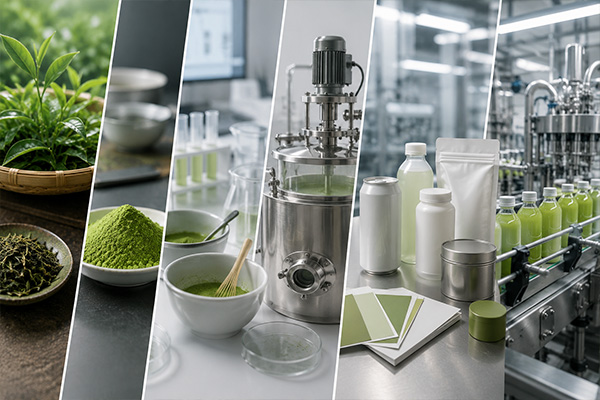
For beverage brands, matcha is more than a trendy green ingredient. It can become the foundation of a new product line, a café-inspired drink concept, a functional beverage, or a premium ready-to-mix powder. But turning matcha from an idea into a commercial beverage product requires more than choosing a nice-looking green powder.
A successful matcha beverage project needs a clear product concept, the right matcha grade, formula testing, cost planning, packaging decisions, production preparation, documentation, and a reliable supply plan.
This guide walks beverage brands through the full development journey — from early concept to commercial production — and explains what B2B buyers should prepare before sourcing matcha powder for beverage products.
Why Matcha Beverage Projects Need a Clear Development Process
Many beverage projects start with a simple idea:
“We want to launch a matcha drink.”
But this is not enough for product development. A bottled matcha latte, a matcha oat milk drink, a powdered latte mix, and a functional matcha beverage may all use matcha powder, but they require very different technical decisions.
A clear development process helps beverage brands avoid common problems such as:
- Choosing a grade that looks good in dry powder but performs poorly in the finished drink
- Building a formula without checking sediment or color stability
- Selecting packaging before confirming powder behavior
- Miscalculating cost per serving or bottle
- Printing labels before document review
- Moving to bulk production without pilot testing
- Choosing a supplier that cannot support repeat orders
For beverage brands, matcha development should be treated as a structured project, not a simple ingredient purchase.
Stage 1: Define the Beverage Concept
Before requesting matcha samples, define the beverage concept clearly. This saves time and helps your supplier recommend suitable grades from the beginning.
Key Concept Questions
Ask your team:
What type of beverage are we developing?
Is it RTD, powder mix, café concentrate, sachet, or foodservice base?
Will the product be milk-based, plant-based, clear, sparkling, or functional?
Who is the target consumer?
What is the target price point?
Will the product be premium, organic, clean-label, or cost-efficient?
What packaging format will be used?
What markets will the product be sold in?
The more specific your concept is, the easier it becomes to choose matcha powder that fits the final product.
Beverage Concept Examples
| Beverage Concept | Matcha Requirement | Development Focus |
|---|---|---|
| Bottled matcha latte | Good milk performance | Color, taste, sediment, sweetness |
| Bebida de matcha con leche de avena | Plant milk compatibility | Mouthfeel, bitterness control, color |
| Limonada de matcha | Acid tolerance | Color change, flavor balance, sediment |
| Matcha protein drink | Ingredient compatibility | Taste masking, texture, stability |
| Matcha latte en polvo | Dry blending performance | Flowability, reconstitution, moisture |
| Single-serve matcha sachet | Convenience and consistency | Dosage, packaging, ease of use |
| Foodservice drink base | Operational efficiency | Mixing speed, cost per serving, consistency |
A strong concept brief helps prevent the project from moving in too many directions at once.
Stage 2: Create a Matcha Product Brief
A product brief is a simple but powerful tool. It helps your internal team and your supplier understand the same goal.
What to Include in the Brief
Your matcha beverage brief should include:
- Product type
- Mercado objetivo
- Beverage base
- Matcha taste preference
- Color expectation
- Nivel de dulzor
- Formato de envase
- Serving size
- Certification needs
- Target cost
- Expected launch quantity
- Required documents
- Timeline
Sample Product Brief Format
| Artículo | Example |
| Product type | RTD oat milk matcha latte |
| Mercado objetivo | Premium café-style beverage for retail |
| Beverage base | Oat milk |
| Matcha profile | Bright green, balanced bitterness, visible tea flavor |
| Sweetness | Lightly sweetened |
| Embalaje | 250ml bottle |
| Certification | Organic option preferred |
| Target customer | Young urban consumers, plant-based drink buyers |
| First order goal | Pilot batch before retail launch |
| Main concern | Color stability and sediment after storage |
With this brief, your supplier can recommend more relevant matcha options instead of sending random samples.
Stage 3: Choose the Right Matcha Direction
Beverage brands should choose matcha based on the product system, not only grade name.
Matcha de grado Latte
Calidad para café con leche is often the best starting point for milk-based beverages and café-style drinks.
Ideal para:
- Latte de matcha
- Bebida de matcha con leche de avena
- Coconut matcha beverage
- Matcha milk tea
- Matcha smoothie base
- Powdered latte mixes
It usually provides a practical balance of color, flavor strength, milk compatibility, and cost.
Matcha de calidad culinaria
Apto para uso culinario may be suitable when the beverage is sweetened, blended with other flavors, or positioned as a cost-sensitive product.
Ideal para:
- Sweetened beverage bases
- Functional blends
- Powdered drink mixes
- Beverage products where matcha is one of several ingredients
Matcha ceremonial
Ceremonial grade can be used for premium beverage concepts, but it is not always necessary for mass-market beverage products.
Ideal para:
- Premium matcha shots
- High-end bottled matcha products
- Luxury tea beverage lines
- Retail products where taste and grade story are central
Matcha ecológico
Organic matcha is suitable for brands targeting organic retailers, clean-label channels, wellness products, and premium natural food markets.
Ideal para:
- Organic RTD beverages
- Organic powdered drink mixes
- Natural food retailers
- Wellness beverage brands
- Productos premium de marca blanca
Beverage Grade Selection Table
| Beverage Type | Suggested Matcha Direction | Why |
| Latte de matcha | Calidad para café con leche | Performs well with milk |
| Oat milk matcha | Latte grade or organic latte grade | Balances color and plant milk taste |
| Sweetened drink mix | Para café con leche o uso culinario | Needs flavor strength and cost control |
| Functional beverage | Culinary, latte, or organic | Depends on formula and positioning |
| Premium straight matcha drink | Ceremonial grade | Better smoothness and premium appeal |
| Organic beverage line | Matcha ecológico | Supports organic market positioning |
Final grade choice should always be confirmed through formula testing.
Stage 4: Test Matcha in the Real Beverage System
Testing matcha in plain water is useful, but it does not predict how the matcha will perform in a real beverage formula.
A beverage brand should test matcha in the actual product system as early as possible.
What to Test in Liquid Beverages
For bottled or canned beverages, evaluate:
- Color tras la mezcla
- Taste after sweetening
- Sediment after standing
- Mouthfeel
- Aroma
- Interaction with milk or plant-based milk
- Behavior after heat treatment
- Stability during storage
- Appearance after shaking
- Taste after refrigeration or ambient storage
What to Test in Powdered Beverages
For powdered drink mixes, evaluate:
- Dry blend uniformity
- Powder flow
- Clumping
- Reconstitution in water or milk
- Taste after mixing
- Color in final drink
- Moisture sensitivity
- Sachet or pouch compatibility
A Practical Test Plan
| Test Stage | What to Do | What to Record |
| Bench test | Mix small formula samples | Taste, color, mouthfeel |
| Milk test | Test with dairy and plant-based milk | Color, sweetness, bitterness |
| Standing test | Leave drink for 30 minutes to several hours | Sediment and separation |
| Heat test | Apply intended processing condition | Color and flavor changes |
| Storage test | Store sample under expected conditions | Shelf appearance and taste |
| Reconstitution test | Test powder mix after storage | Clumping and drink quality |
This stage helps identify whether the selected matcha is suitable before larger costs are committed.
Stage 5: Balance Flavor, Color and Cost
Beverage development often requires compromise. The brightest green matcha may not be the best cost option. The smoothest matcha may not stand out in milk. The lowest-cost matcha may not create a good finished drink.
A practical formula must balance:
- Visual appeal
- Flavor strength
- Bitterness
- Sweetness
- Mouthfeel
- Matcha dosage
- Cost per serving
- Shelf stability
- Brand positioning
Cost per Serving Matters More Than Price per Kilogram
For beverage brands, price per kilogram is only one part of the decision.
A better calculation is:
Matcha Cost per Serving = Matcha grams per serving × Matcha cost per gram
For RTD beverages:
Matcha Cost per Bottle = Matcha grams per bottle × Matcha cost per gram
For powdered drinks:
Matcha Cost per Sachet = Matcha grams per sachet × Matcha cost per gram
This helps brands choose a matcha that supports both product quality and commercial pricing.
Beverage Cost Planning Table
| Product Format | Key Cost Question |
| RTD bottle | What is matcha cost per bottle? |
| Powder pouch | What is matcha cost per serving? |
| Stick pack | What is matcha cost per sachet? |
| Foodservice base | What is matcha cost per drink? |
| Premium beverage | Does the grade support higher retail pricing? |
| Organic beverage | Does the organic positioning justify the added cost? |
The right matcha is not always the cheapest one. It is the one that supports the product’s quality, price point, and market position.
Stage 6: Prepare for Pilot Production
Once bench testing is approved, the next step is pilot production. This stage checks whether the formula works outside the lab or sample kitchen.
What Pilot Production Should Confirm
Pilot production should review:
- Formula scalability
- Mixing process
- Dispersión de polvos
- Sediment behavior
- Processing temperature
- Filling compatibility
- Packaging compatibility
- Taste after production
- Color after production
- Quality control parameters
- Production loss or waste
Pilot Batch Questions
Before pilot production, ask:
Will the matcha be added dry or pre-dispersed?
What mixing equipment will be used?
What processing temperature will the formula experience?
Will the beverage be refrigerated or shelf-stable?
Will the packaging block light?
Will sediment be acceptable or controlled?
How will batch quality be checked?
This stage is especially important for RTD and powdered beverage brands moving from samples to commercial production.
Stage 7: Choose Packaging Based on Product Format
Packaging should be selected based on the beverage format, not only brand design.
RTD Beverage Packaging
For RTD products, packaging may include:
- PET bottles
- Glass bottles
- Cans
- Cartons
- Aseptic packaging
Important considerations include:
- Light exposure
- Oxygen protection
- Shelf-life requirements
- Refrigerated or ambient storage
- Label space
- Shake-before-drinking instructions
- Retail display conditions
Powdered Beverage Packaging
For powder products, packaging may include:
- Bolsas verticales
- Sobres monodosis
- Sachets
- Tins
- Jars
- Bulk foodservice bags
Important considerations include:
- Moisture barrier
- Resealing
- Serving convenience
- Powder flow
- Filling accuracy
- Label instructions
- Shelf appearance
Foodservice Beverage Packaging
For café chains or foodservice beverage brands, practical packaging may include:
- 500g bags
- 1kg foil bags
- 5kg cartons
- Portion packs
- Pre-measured sachets
The goal is easy preparation, stable taste, and efficient storage.
Stage 8: Review Label and Document Needs
Before commercial production, beverage brands should confirm what documents and label information are needed.
Common Documents
Documents may include:
- COA
- Ficha técnica del producto
- Shelf life statement
- Storage instructions
- Certificado ecológico, si procede
- Ingredient statement
- Nutrition information
- Especificaciones del embalaje
- Commercial invoice
- Packing list
- Certificate of origin, if required
Label Information to Prepare
For finished beverage products, brands may need:
- Product name
- Net content
- Ingredient list
- Nutrition facts or nutrition information
- Allergen information
- Storage instructions
- Preparation instructions for powder drinks
- Best-before date area
- Batch number area
- Importer or distributor information
- Organic logo and certifier details, if applicable
For organic beverage products, label review should happen before packaging production.
Stage 9: Build a Production and Supply Plan
A beverage project does not end after the first production run. The brand needs a supply plan for repeat orders, future flavors, and possible scale-up.
What to Plan
Before launch, confirm:
- First production quantity
- Matcha MOQ
- Packaging MOQ
- Production lead time
- Reorder lead time
- Safety stock
- Condiciones de almacenamiento
- Batch consistency plan
- Supplier communication process
- Future product line expansion
Repeat Supply Questions
Ask your supplier:
Can this matcha grade be supplied regularly?
How much notice do you need for repeat orders?
Will the color and flavor remain consistent?
Can you support larger quantities if the product grows?
Can you support additional beverage concepts later?
A reliable supply plan helps prevent out-of-stock issues after launch.
From Concept to Production: Beverage Development Roadmap
| Stage | Main Goal | Key Output |
| Concept | Define product direction | Product brief |
| Selección de cursos | Choose matcha direction | Sample shortlist |
| Formula testing | Test in real beverage system | Approved matcha sample |
| Cost planning | Check serving or bottle cost | Target cost model |
| Pilot production | Test scale-up performance | Pilot batch results |
| Embalaje | Confirm pack format | Especificaciones del embalaje |
| Label review | Prepare market-ready content | Approved label draft |
| Documentación | Confirm supplier documents | COA and specification set |
| Production | Produce commercial batch | Finished goods |
| Supply planning | Prepare repeat orders | Reorder plan |
This roadmap helps beverage brands manage matcha development as a complete project instead of a one-time ingredient purchase.
Product Development Example: Matcha Oat Milk Drink
A beverage brand wanted to develop a matcha oat milk drink for retail. The brand wanted a clean, café-style product with a smooth taste and attractive green color.
Development Goals
The product needed:
- Good color in oat milk
- Balanced bitterness
- Smooth mouthfeel
- Stable taste after storage
- Practical cost per bottle
- Packaging suitable for retail
- Documents for purchasing and quality review
Testing Process
The team compared three matcha samples:
| Sample | Result |
| Sample A | Bright dry powder but weak color in oat milk |
| Sample B | Strong tea flavor but too bitter |
| Sample C | Balanced color, taste, and cost in oat milk |
The brand selected Sample C and adjusted sweetness, dosage, and mixing process during pilot testing.
Final Learning
The best matcha was not the brightest dry powder or the cheapest quote. It was the sample that worked best in the real oat milk formula.
Product Development Example: Matcha Latte Powder
A private label beverage brand wanted to launch a matcha latte powder in pouches and stick packs.
Main Challenges
The brand needed to check:
- Dry blend uniformity
- Matcha taste after mixing
- Clumping after storage
- Powder flow during filling
- Serving size
- Packaging moisture barrier
- Label instructions
Development Approach
The project started with a latte-grade matcha sample and tested different sweetness levels. The supplier then helped review pouch options, stick pack feasibility, and first-order MOQ.
Final Learning
For powdered beverage products, matcha performance is not only about flavor. Powder flow, moisture protection, and reconstitution are equally important.
Common Mistakes Beverage Brands Should Avoid
Mistake 1: Starting with Packaging Before Formula Testing
Beautiful packaging cannot fix a formula that has poor color, sediment, or taste.
Mistake 2: Choosing Matcha Only by Dry Powder Appearance
Dry powder color is only the first impression. The finished beverage matters more.
Mistake 3: Not Testing in the Actual Beverage Base
Milk, oat milk, coconut milk, acidic drinks, protein systems, and sweetened formulas all affect matcha differently.
Mistake 4: Ignoring Sediment in RTD Drinks
Sedimentation should be tested early, especially for bottled or carton beverages.
Mistake 5: Forgetting Cost per Bottle or Serving
Bulk price per kilogram does not show the full business picture. Always calculate cost per finished unit.
Mistake 6: Not Planning Repeat Supply
A successful beverage launch needs stable supply after the first batch.
How MatchaOEMFactory Supports Beverage Brands
MatchaOEMFactory helps beverage brands develop matcha products from early concept to commercial production.
Ofrecemos asistencia para:
- Matcha grade recommendation for beverage applications
- Opciones de matcha para café con leche, uso culinario, ceremonias y de cultivo ecológico
- Muestras de matcha a granel para pruebas de fórmulas
- Matcha solutions for RTD beverages, powdered drink mixes, café bases, and private label products
- Asistencia para la elaboración de mezclas personalizadas de matcha
- Packaging option planning
- Asistencia en materia de COA y especificaciones
- Cantidad mínima de pedido y planificación de costes
- Documentación lista para la exportación
- Asistencia para pedidos recurrentes
Whether you are developing a bottled matcha latte, oat milk matcha drink, powdered latte mix, foodservice drink base, or private label beverage product, our team can help you compare suitable matcha options and prepare a practical sourcing plan.
Preguntas frecuentes
What matcha grade is best for beverage brands?
Latte grade matcha is often a good starting point for milk-based beverages, oat milk drinks, and café-style products. Culinary or organic matcha may also be suitable depending on the formula and positioning.
Should beverage brands test matcha in water first?
Water testing can help compare basic color and taste, but the final decision should be based on testing in the real beverage system.
How can brands reduce sediment in matcha beverages?
Sediment can be managed through powder fineness, mixing process, formula design, stabilizers, packaging, and shake-before-drinking instructions.
Can matcha be used in powdered drink mixes?
Yes. Matcha can be used in latte powders, smoothie powders, protein blends, sachets, and stick packs. Powder flow and moisture protection should be tested.
Is organic matcha suitable for beverage products?
Yes, organic matcha can support premium, clean-label, and natural beverage positioning. Certification, label review, and documentation should be planned early.
Can MatchaOEMFactory support beverage product development?
Yes. We provide matcha samples, grade recommendations, bulk supply, custom blending, packaging options, COA support, and export-ready documentation for beverage brands.
Ready to Develop a Matcha Beverage Product?
A successful matcha beverage starts with a clear concept, the right matcha grade, real formula testing, practical packaging, and reliable supply support.
MatchaOEMFactory helps beverage brands move from product idea to production with bulk matcha powder, sample testing, grade recommendations, custom matcha solutions, packaging support, and documentation.
Share your beverage concept, target market, expected quantity, and packaging format. Our team can help you compare matcha options and prepare a tailored quotation for your project.