
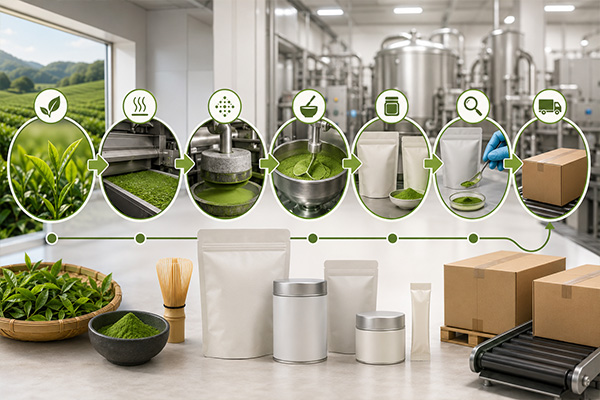
For businesses aiming to launch a private label matcha product, understanding how OEM matcha manufacturing works is essential. OEM (Original Equipment Manufacturer) matcha allows brands to source high-quality matcha powder, customize packaging, and offer products under their own branding without owning a production facility.
This guide explains the steps involved in OEM matcha manufacturing, what B2B buyers should consider, and how to ensure a successful private label launch.
What OEM Matcha Manufacturing Means
OEM matcha manufacturing is a service provided by specialized matcha suppliers who produce or package matcha products for other brands. These suppliers handle the sourcing, blending, packaging, quality control, and documentation while the brand focuses on marketing, sales, and distribution.
Key advantages of OEM matcha:
- Access to a range of matcha grades: ceremonial, latte, culinary, ingredient, organic
- Private label packaging options: pouches, tins, sachets, kits
- Bulk purchasing with controlled MOQ
- Professional COA and quality documentation
- Time and cost efficiency for new brands
OEM manufacturing allows brands to focus on sales channels and brand development without investing in production infrastructure.
Step 1: Define Your Product Concept
Before engaging an OEM supplier, clearly define your product concept. This will guide grade selection, packaging, labeling, and MOQ planning.
Questions to answer:
- Is the product a ready-to-drink beverage, a retail matcha pouch, a latte mix, or a gift kit?
- What grade of matcha fits the application (ceremonial, latte, culinary, or ingredient)?
- Will the product be organic or conventional?
- What is the target market and price point?
- What is the expected order quantity or launch batch size?
A clear product concept helps the supplier recommend the right grade and packaging format and reduces unnecessary costs or revisions.
Step 2: Choose the Matcha Grade
Selecting the correct grade is critical for your product performance and consumer experience.
- Ceremonial grade: Premium retail or high-end beverage applications.
- Calidad para café con leche: Milk-based drinks, café menus, and smoothies.
- Culinary grade: Baking, desserts, and functional food applications.
- Ingredient grade: Functional blends, supplements, and RTD beverages.
The supplier can help match grade with application and guide you on cost implications and batch availability.
Step 3: Sampling and Testing
Once a grade is selected, the supplier provides samples for testing.
- Test the matcha in your intended product to confirm color, flavor, aroma, and solubility.
- For food and beverage applications, test in milk, water, or recipes.
- For supplements or blends, evaluate powder flow, mixing, and stability.
Sampling ensures that the bulk order will meet your expectations and reduces the risk of product inconsistency.
Step 4: Packaging and Label Selection
OEM matcha suppliers provide packaging solutions to suit different market needs:
- Bulk bags: Ideal for cafés, foodservice, and manufacturing.
- Stand-up pouches: Flexible for retail or e-commerce private label products.
- Tins and jars: Premium retail or gift products.
- Stick packs or sachets: Convenient for single servings or subscription products.
- Gift kits: Include matcha powder plus accessories for a complete consumer experience.
Labeling should be prepared according to regulatory requirements, including ingredient lists, storage instructions, shelf life, batch numbers, and certifications.
Step 5: MOQ and Production Planning
MOQ for OEM matcha can vary depending on:
- Matcha grade and batch availability
- Packaging format (pouch, tin, sachet, kit)
- Private label customization requirements
- Organic certification or other compliance needs
Planning MOQ early helps determine order size, cost per unit, and lead time.
Step 6: Quality Assurance and Documentation
A reliable OEM supplier provides full quality documentation:
- Certificate of Analysis (COA) for batch verification
- Product specification sheets
- Organic, Halal, or Kosher certifications if applicable
- Shelf life and storage information
- Export documentation for international shipping
These documents ensure product safety, compliance, and consistency for repeat orders.
Step 7: Production and Filling
After approval of grade, sample, packaging, and documentation:
- The supplier produces the batch according to specifications.
- Powder is packed into selected packaging formats.
- Labels are applied, and quality checks are conducted.
- Batch photos and COAs are provided before shipping.
Step 8: Shipping and Logistics
Suppliers can support international shipping including:
- Bulk powder export
- Private label retail packaging
- Coordinated logistics for air, sea, or express shipments
B2B buyers should clarify shipping terms, lead times, and documentation requirements.
Step 9: Repeat Orders and Supply Planning
OEM suppliers should support repeat orders to maintain consistency:
- Same grade and batch quality
- Consistent packaging format
- Document continuity (COA and specifications)
- MOQ planning for subsequent batches
Repeat order support is critical for brand stability, customer trust, and production planning.
Preguntas frecuentes
Q: Can I customize matcha blends in OEM manufacturing?
A: Yes, many OEM suppliers offer custom blends for private label products, including flavored or functional formulations.
Q: Do I need to provide my own packaging design?
A: You can provide artwork, or suppliers can assist with design services depending on the agreement.
Q: How long does an OEM private label matcha order usually take?
A: Lead times vary based on grade, packaging, and batch size, but typically include sample approval, production, packaging, and shipping stages.
Q: Can I order small quantities for a trial launch?
A: Yes, stock packaging or limited first-order quantities are often possible, though custom packaging may require higher MOQ.
Q: What documents should I receive from the OEM supplier?
A: COA, specification sheets, certifications (organic, Halal, Kosher), shelf life information, and export documents.
Ensure a Smooth Private Label Matcha Launch
OEM matcha manufacturing allows brands to focus on sales, branding, and marketing while leveraging professional matcha production, packaging, and quality control. By understanding each step—from grade selection to packaging, documentation, and shipping—B2B buyers can plan a private label matcha product with confidence.