
When sourcing matcha in bulk, quality evaluation is crucial for ensuring that your product meets customer expectations, maintains brand standards, and performs well in recipes or beverages. B2B buyers—including cafés, food and beverage brands, distributors, supplement companies, and private label operators—need more than just attractive packaging or price: evaluating the product itself before placing a bulk order can prevent costly mistakes.
This guide explains the main aspects of matcha quality evaluation and practical steps for buyers before committing to a supplier.
Understanding Matcha Quality
Matcha quality is determined by a combination of factors:
- Grade: Ceremonial, latte, culinary, or ingredient grade.
- Color: Vibrant green indicates younger, high-quality leaves and proper processing.
- Texture and Fineness: Fine powder is essential for smooth beverages and uniform mixing in recipes.
- Aroma and Taste: High-quality matcha has a fresh, vegetal aroma and a balanced umami taste with mild bitterness.
- Moisture: Properly dried matcha avoids clumping and extends shelf life.
- Purity and Traceability: The product should be free from additives, fillers, or contaminants.
Evaluating these factors helps B2B buyers ensure consistency across orders and applications.
Step 1: Check the Grade and Intended Use
The first step is identifying which grade of matcha fits your application:
- Ceremonial Grade: Ideal for traditional tea ceremonies or high-end retail products; delicate flavor and fine texture.
- Latte Grade: Balanced for milk-based drinks, smoothies, and café menus.
- Culinary Grade: Stronger flavor and color for baked goods, desserts, and cooking.
- Ingredient Grade: Suitable for bulk formulations, RTD drinks, or supplements where cost efficiency is key.
Using the appropriate grade ensures flavor consistency, reduces waste, and improves customer satisfaction.
Step 2: Visual Inspection – Color and Texture
Color and texture are immediate indicators of matcha quality.
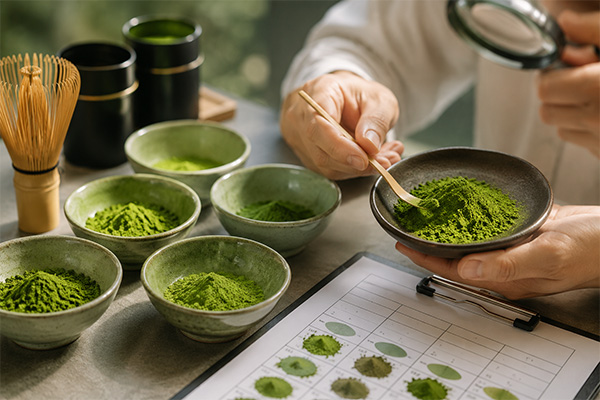
- Color: High-quality matcha is a bright, vivid green. Dull, yellowish, or brownish powders indicate older leaves, poor shading, or improper storage.
- Texture/Fineness: The powder should be smooth and uniform, without coarse particles or clumps. This affects solubility, mouthfeel, and suspension in beverages or blending in recipes.
B2B buyers can request sample bowls or small bulk packs to visually inspect the product under consistent lighting and compare multiple suppliers.
Step 3: Aroma and Taste Testing
A matcha’s aroma and taste reveal both freshness and quality of the leaves.
- Aroma: High-quality matcha has a fresh, grassy, and vegetal fragrance. Any musty, stale, or off-notes indicate poor storage or low-quality leaves.
- Taste: Look for balanced umami, slight sweetness, and mild bitterness. Extremely bitter or astringent powders may indicate poor leaf selection or improper processing.
For practical evaluation, test matcha in the intended application:
- Lattes or milk-based drinks
- Baking or dessert formulas
- RTD beverages or powder blends
Step 4: Evaluate Physical and Chemical Parameters
Bulk matcha quality is often defined by measurable parameters:
- Moisture Content: Ideal levels prevent clumping, microbial growth, and reduced shelf life.
- Particle Size / Mesh: Affects mouthfeel, blending, and dispersion in liquids or powders.
- Heavy Metals and Pesticides: Ensure compliance with food safety regulations in your market.
- Polyphenols and Caffeine: Optional for functional beverage or supplement applications; ensures batch consistency.
Suppliers often provide these values in a Certificate of Analysis (COA) or specification sheet.
Step 5: Conduct Sample Testing in Real Applications
Never evaluate matcha solely based on a dry sample. Test it under real-world conditions:
- Mix in hot water, milk, or plant-based alternatives for café drinks.
- Blend into baked goods, chocolate, or desserts for flavor and color retention.
- Incorporate into RTD beverages or supplement powders to check solubility, taste stability, and visual appearance.
Testing in context ensures the matcha will perform consistently in production and consumer-facing applications.
Step 6: Confirm Batch Consistency
Batch-to-batch consistency is critical for repeat orders. Ask suppliers:
- Are samples representative of bulk production?
- Are quality metrics maintained across batches?
- Can the supplier guarantee consistent color, flavor, and aroma?
This protects your brand, minimizes reformulation, and reduces risk of customer complaints.
Step 7: Verify Documentation
Even if matcha looks and tastes excellent, documents verify compliance:
- Certificate of Analysis (COA): Confirms test results for moisture, heavy metals, pesticides, and other critical indicators.
- Specification Sheet: Details grade, particle size, flavor, and color standards.
- Certification: Organic, Halal, or Kosher if relevant.
- Shelf Life & Storage Instructions: Ensures proper handling through distribution.
Having accurate documents helps buyers make informed decisions and satisfy import or regulatory requirements.
Step 8: Evaluate Supplier Transparency and Support
Finally, a supplier’s ability to provide information and guidance is part of quality evaluation:
- Do they explain grade differences clearly?
- Can they provide accurate COAs and documentation for each batch?
- Do they assist with sample testing and application recommendations?
- Can they support private label packaging or custom blends?
Transparent suppliers make bulk ordering smoother, reduce risk, and improve confidence in product performance.
Practical Checklist for Evaluating Matcha Quality
| Step | What to Check |
|---|---|
| Grade | Appropriate for application (ceremonial, latte, culinary, ingredient) |
| Appearance | Bright, vivid green; smooth texture |
| Aroma | Fresh, vegetal, free of off-notes |
| Taste | Balanced umami, mild bitterness, appropriate flavor for application |
| Moisture | Within recommended limits to prevent clumping |
| Particle Size | Fineness suitable for beverage, baking, or powder blend |
| Heavy Metals | Within safe limits for your target market |
| Pesticides | Within acceptable range or certified organic |
| Sample Testing | Tested in real product or recipe |
| Batch Consistency | Supplier can maintain quality across orders |
| Documentation | COA, specification sheet, certification, storage guidance |
| Supplier Support | Transparent, responsive, application guidance provided |
Common Mistakes Buyers Make
- Judging only by color or price: High-quality matcha involves more factors than just appearance.
- Not testing in the real application: Powders may behave differently in beverages or baked products than in dry form.
- Ignoring batch variation: One sample may not represent the bulk shipment.
- Skipping documentation review: COA, certificates, and specification sheets are essential for quality verification and compliance.
- Assuming one grade fits all applications: Latte-grade may not work in baking, and ingredient-grade may not perform well in high-end retail beverages.
How MatchaOEMFactory Helps Ensure Quality
MatchaOEMFactory supports B2B buyers with:
- Application-based grade recommendations
- Bulk matcha samples for testing
- Ceremonial, latte, culinary, and ingredient-grade options
- COA and specification sheet provision
- Guidance on moisture, fineness, color, and aroma
- Advice on batch consistency for repeat orders
- Private label and custom blend support
By evaluating matcha with practical testing, proper documentation, and supplier guidance, buyers can make informed bulk ordering decisions.
FAQ
Q: Can I rely on appearance alone to evaluate matcha quality?
A: No. Appearance is important, but you must also test taste, aroma, texture, and performance in your intended application.
Q: How many samples should I test before bulk ordering?
A: Ideally, test two or three batches to ensure consistency across multiple lots.
Q: Should I consider moisture and particle size when evaluating matcha?
A: Yes. Moisture affects clumping and shelf life, while particle size affects solubility, blending, and mouthfeel.
Q: Do all suppliers provide a COA?
A: Reputable B2B suppliers should provide a batch-specific COA. If not, request one before placing a bulk order.
Q: Can a COA replace sample testing?
A: No. COA confirms quality metrics, but real-world testing ensures the product performs as expected in your recipes or beverages.
Ensure Consistent Quality Before Bulk Ordering
Evaluating matcha quality is a critical step for B2B buyers. Consider grade, color, aroma, taste, moisture, particle size, batch consistency, and documentation. Test samples in your actual application and confirm all quality metrics with the supplier to reduce risk and ensure customer satisfaction.