
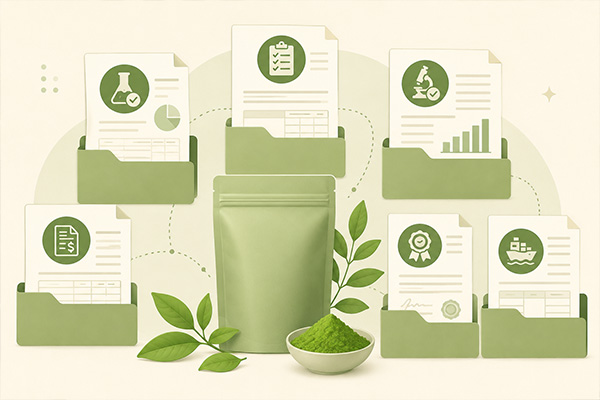
When sourcing matcha for your business, having the right documents from your supplier is just as important as the product itself. For B2B buyers—including cafés, beverage brands, distributors, food manufacturers, supplement companies, and private label brands—documents provide confidence in quality, compliance, and consistency. They ensure the matcha meets safety, regulatory, and commercial requirements before it reaches your production line or shelf.
This guide explains which documents a matcha supplier should provide, why each is important, and how they support your business decisions.
Understanding the Role of Supplier Documents
Documents from a matcha supplier are more than paperwork—they are proof of quality, safety, and traceability. They allow you to:
- Verify that the matcha meets your intended use, whether for lattes, baked goods, RTD beverages, or retail packs.
- Confirm quality standards, batch consistency, and ingredient authenticity.
- Ensure compliance with local or international regulations.
- Support internal quality assurance, customer reassurance, and labeling requirements.
Without proper documentation, B2B buyers risk receiving substandard matcha, regulatory issues, or product inconsistencies that can affect both brand reputation and operational efficiency.
Key Documents Every Matcha Supplier Should Provide
1. Certificate of Analysis (COA)
A COA is a batch-specific document that outlines test results for a particular shipment of matcha powder. It typically includes:
- Physical characteristics: color, texture, and appearance
- Moisture content
- Microbiological indicators: total plate count, yeast, mold, E. coli, Salmonella
- Heavy metals: lead, cadmium, arsenic, mercury
- Pesticide residues
- Particle size or mesh size
Why it matters: The COA allows buyers to confirm the matcha meets quality and safety standards before it is used in production or sold.
2. Product Specification Sheet
A specification sheet defines the expected standards for the product, such as:
- Matcha grade (ceremonial, latte, culinary, ingredient)
- Color range
- Flavor and aroma description
- Texture/fineness
- Moisture and shelf life ranges
Why it matters: Buyers can compare supplier claims to their own requirements and decide whether the grade is suitable for their applications.
3. Organic Certification (If Applicable)
For organic matcha, suppliers should provide certification issued by an authorized body, such as:
- USDA Organic (for the United States)
- EU Organic Certification (for Europe)
- JAS Certification (for Japan)
Why it matters: Organic certification is mandatory for labeling and selling in organic markets, ensuring your product meets regulatory standards and consumer expectations.
4. Food Safety and Quality Management Certificates
Depending on the target market, matcha suppliers may provide:
- ISO 22000 Food Safety Management
- HACCP Certification
- GMP (Good Manufacturing Practices)
- Halal or Kosher Certification, if applicable
Why it matters: Certifications demonstrate that the supplier follows recognized production and safety protocols, which is critical for importers, distributors, and private label brands.
5. Export and Shipping Documents
Suppliers should provide documents to facilitate international shipping, such as:
- Commercial invoice
- Packing list
- Bill of lading or airway bill
- Export declaration
- Certificates of origin
Why it matters: These documents help you comply with customs regulations, calculate duties, and ensure smooth delivery.
6. Test Reports and Lab Analysis
Some buyers may require additional lab testing beyond the standard COA, such as:
- Heavy metal detailed analysis
- Microbiological testing
- Pesticide residue verification
- Caffeine and polyphenol content
Why it matters: Independent or detailed lab reports provide an extra layer of assurance for quality-critical applications like beverages, supplements, and food products.
7. Shelf Life and Storage Guidelines
Suppliers should clearly state:
- Shelf life (from production date)
- Recommended storage conditions (temperature, humidity, light exposure)
- Packaging type and protection method
Why it matters: Proper storage ensures that color, aroma, and taste remain consistent from supplier to end consumer, which is especially important for cafés, retail brands, and private label products.
8. Traceability and Batch Records
Traceability documents connect each batch to:
- Harvest location
- Production date
- Processing method
- Quality tests conducted
Why it matters: Traceability allows buyers to identify and resolve quality issues quickly, maintain regulatory compliance, and support claims for premium or certified products.
Tips for Using Supplier Documents Effectively
- Verify Batch Match: Ensure that the COA and specification sheet match the actual batch being shipped. Avoid generic documents that may not reflect the specific order.
- Check Expiration Dates: Look for production dates and shelf life to ensure freshness, especially for private label or retail products.
- Cross-Reference Certifications: Confirm that any organic, Halal, or Kosher certificates correspond to the product and batch.
- Align with Applications: Evaluate whether the documented properties match your intended application (latte, bakery, RTD, supplement, or private label).
- Request Third-Party Verification if Needed: For high-volume or high-value orders, consider additional testing by an independent lab.
Common Mistakes Buyers Make With Matcha Documents
- Assuming COA alone is sufficient: COA should be reviewed with the specification sheet and sample testing.
- Ignoring batch numbers: Using a generic COA can result in inconsistencies.
- Not reviewing certification scope: Organic certificates may not cover all claimed batches.
- Skipping storage and shelf life details: This can lead to product degradation during storage or shipping.
- Failing to confirm export documents: Can cause delays in customs clearance or regulatory compliance.
How MatchaOEMFactory Supports Document Transparency
MatchaOEMFactory provides comprehensive documentation for all B2B matcha orders:
- Batch-specific COA and specification sheets
- Organic, Halal, Kosher, and food safety certificates
- Export and shipping documents
- Shelf life and storage recommendations
- Traceability information
Our team helps buyers understand and review documents before placing bulk orders, ensuring that quality, compliance, and application requirements are met.
FAQ
Q: Is a COA required for every matcha order?
A: While small internal orders may not always require a COA, for bulk, private label, or imported matcha, a COA is essential for quality verification and regulatory compliance.
Q: How can I tell if a COA is authentic?
A: Check batch numbers, production dates, issuing company, test parameters, and whether the document matches the actual shipment.
Q: Are specification sheets and COAs the same?
A: No. A COA shows test results for a specific batch, while a specification sheet outlines standard expected ranges or quality parameters.
Q: Should I request additional third-party testing?
A: For high-value, organic, or critical applications, additional lab verification is recommended.
Q: What happens if the COA and sample don’t match?
A: You should address this with the supplier immediately. A mismatch may indicate a batch quality issue or a documentation error.
Ensure Your Bulk Matcha Orders Are Supported by Complete Documentation
Having the right documents from your matcha supplier protects your business, ensures regulatory compliance, and supports consistent product quality.
Before placing a bulk order, confirm that your supplier provides COA, specification sheets, certifications, shipping documentation, shelf life guidance, and traceability records. Doing so reduces risk, improves confidence in your product, and ensures smooth operations from production to retail or café service.